AI for Smarter and Faster A/B Testing
Karl Marais | 29 May 2026

Imagine spending countless hours on A/B testing, painstakingly tweaking headlines and buttons, only to see barely any improvement.
Traditional methods can feel like you’re throwing spaghetti at the wall. The solution is smarter testing, with AI automation.
Introduction to AI in A/B Testing
AI is transforming A/B testing by making data-driven decisions faster, smarter, and far more effective for modern conversion rate optimization (CRO).
Where A/B testing once required extensive manual labor, AI now rapidly analyzes massive datasets, revealing actionable insights that make digital experience optimization seamless.
Learn more about AI-assisted A/B testing here.
What is AI in A/B Testing?
AI-powered A/B testing uses machine learning and advanced algorithms. This approach enables multi-armed bandit tests and prompt-based experimentation, testing a wide range of variations without the usual resource drain.
Automated analysis replaces guesswork with precision, providing a complete, data-rich view and minimizing errors. In short, AI brings a true paradigm shift to conversion optimization.
Benefits of Integrating AI with Traditional A/B Testing
AI makes testing dramatically more agile. Businesses quickly refine campaigns and optimize experiences in real time, significantly boosting conversion rates and reducing wasted ad spend.
The need for hands-on developer support drops, freeing up teams to react and adapt rapidly. Most importantly, AI uncovers insights traditional testing would miss, helping businesses stay ahead of shifting markets.
Key Features of AI-Powered A/B Testing Tools
Modern AI A/B testing tools bring powerful capabilities to the table, often in an easy-to-use, no-code format.
Features like visual editors let marketers launch experiments quickly without coding expertise, while lightweight scripts maintain fast load times. Integrated feature flags make it easy to roll out or roll back variations safely.
Advanced platforms enable split URL testing for in-depth landing page optimization, and robust personalization engines tailor the user experience to individual behaviors and preferences, increasing the odds of conversion.
By automating the complexity behind the scenes, AI frees you to focus on creative and strategic tasks, turning A/B testing into a powerful competitive advantage.
Implementing AI for Smarter A/B Testing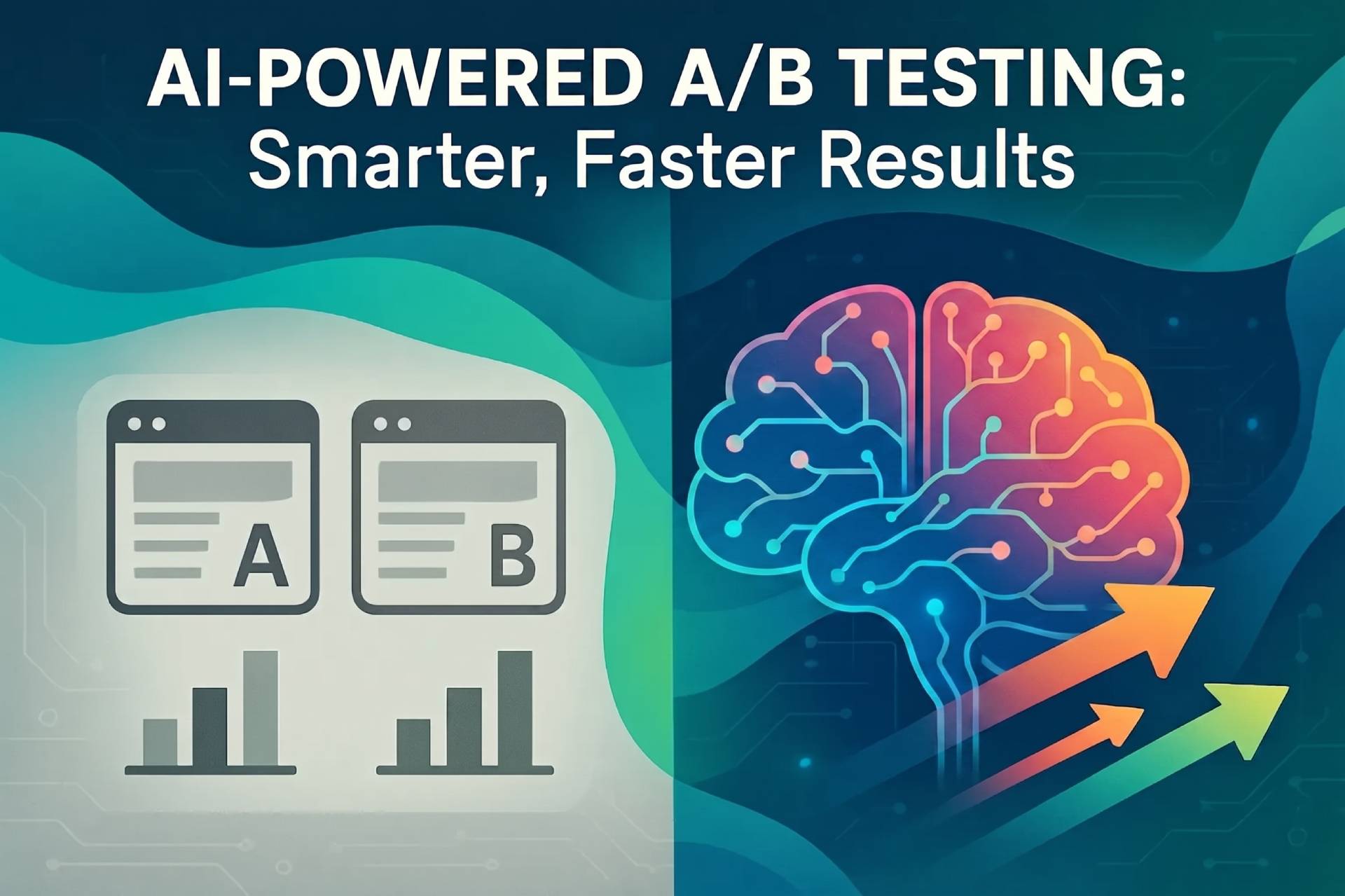
AI-driven testing elevates your optimization strategy from manual guesswork to algorithmic precision. Algorithms quickly identify winning combinations, saving time and uncovering what connects with your audience.
With AI-powered conversion optimization platforms, you gain insights human analysis might miss, directly improving conversion rates.
Choosing the Right AI Tool
Selecting an AI A/B testing platform should align with your specific needs, especially in SaaS or e-commerce.
Assess functionality: does it offer CRO tools, real-time data sync (like GA4 or Tag Manager integration), and flexibility for easy experiment setup? The right fit ensures your marketing and product strategies become more efficient and effective.
Setting Up and Running AI-Driven Tests
Most modern AI platforms allow fast setup, sometimes with a single line of code. Connecting analytics tools, defining audience segments, and establishing clear objectives are key.
Once configured, launch experiments with specific goals and realistic timelines. A solid setup process ensures your AI tests yield relevant, actionable insights, accelerating your workflow and improving accuracy.
Measuring Success and Analyzing Results
Success in AI-powered A/B testing is measured by conversion lifts, improved ROI, and impactful insights. Focus on conversion rate changes, revenue impacts, and other key metrics.
Continuous tracking and robust analysis guide future strategies, ensuring each experiment moves you closer to your business goals.
Overcoming Challenges in AI-Driven Testing
AI unlocks potential, but also brings challenges. Issues like data bias, algorithm transparency, and experiment mismanagement can skew results.
Address these by prioritizing model interpretability, proper result validation, and clear communication. Rigorous frameworks minimize errors and promote actionable, trustworthy data.
Building a robust process, where experiment execution is closely monitored and aligned with real-world goals, ensures AI delivers on its promise without pitfalls.
For more strategies, check out this detailed guide.
Enhancing Conversion Rates with AI
AI boosts conversions by delivering deep behavioral insights and continuous optimization. These platforms analyze user actions at a granular level, allowing for landing page adjustments and content tweaks tailored to real-time audience preferences, automatically improving user experience (UX).
AI enables ongoing refinement, learning from interactions, and anticipating evolving preferences.
This ensures landing pages and offers stay relevant, maximizing conversions over time.
Personalization Strategies
AI-driven personalization crafts individualized experiences. Landing pages and content can be dynamically tailored for each user or audience segment, making each visitor feel recognized, a proven path to higher engagement.
Real-time personalization extends from ad copy to landing pages, matching message and offer for each user’s intent. This results in more relevant journeys and stronger connections, leading to greater conversions and customer loyalty.
Advanced User Targeting
AI supercharges audience targeting. By analyzing behavioral signals and contextual data, you can reach high-intent visitors with messages that truly resonate.
Dynamic segmentation and contextual recommendations help maximize the impact of every user touchpoint, refining lead quality and ROI.
Examples of Effective AI-Enhanced Variations
AI opens new creative frontiers. Automatic generation of headlines, CTAs, and layout changes ensures experiments uncover effective combinations quickly.
AI headline and copy optimizers deliver messaging that captures attention, while UX improvements evolve based on real user feedback.
AI-generated variations provide deeper, faster insights, accelerating decision-making and delivering higher conversion rates.
AI A/B Testing Best Practices
To master A/B testing with AI, develop a solid workflow and apply proven best practices:
- Seamlessly integrate AI into your CRO strategy for precision and scalability.
- Rely on machine learning-driven personalization for test relevance.
- Use AI’s analytic power for actionable insights, and let the platform handle heavy data lifting.
Strategic Traffic Allocation
AI-driven traffic allocation replaces the static 50/50 split with multi-armed bandit testing and dynamic allocation.
This approach steers more visitors towards winning variations in real time, maximizing outcomes quicker while still learning from underperforming options. Progressive rollouts ensure smooth, risk-mitigated deployments.
Continuous Experimentation
Adopt a culture of continuous experimentation, where each test informs the next. AI’s unique strength is its ability to learn rapidly from massive datasets, enabling iterative improvements that scale efficiently. Foster an environment focused on learning to optimize growth.
Future Trends in AI and A/B Testing
AI and experimentation technologies are evolving in leaps and bounds. Generative AI, real-time analytics, and predictive modeling are powering more sophisticated, personalized testing than ever before.
Every test could adapt dynamically to market conditions, giving businesses an indispensable edge.
Companies already leveraging machine learning, autonomous experiments, and contextual bandits are seeing faster, more accurate improvements to digital performance. The future of A/B testing is continuous, data-driven adaptation.
Machine Learning’s Growing Role
Machine learning is at the core of next-generation testing, powering predictive analytics, adaptive experiments, and self-learning systems.
Reinforcement learning allows AI to optimize over time, constantly fine-tuning elements for peak performance based on real-world user feedback.
The Evolution of AI Algorithms
Modern AI algorithms, such as contextual bandits and genetic algorithms, enable hyper-personalization and continuous test evolution.
These systems automatically balance exploration and exploitation, adapting content to maximize results for every user segment, while ensuring experiments never stagnate.
Conclusion
A truly effective AI testing ecosystem requires you to embrace a data-driven, experiment-focused culture. With AI streamlining analysis, discovery, and execution, your business stays agile and competitive.
AI has revolutionized A/B testing. Faster insights, smarter decisions, and better ROI mean your optimization roadmap becomes more strategic and impactful. Integrating AI in your experimentation processes gives you a sustainable edge in today’s fast-paced, digital-first world.
Foster a mindset of ongoing experimentation, iteratively refining your hypotheses, strategies, and user experiences.
Build a testing roadmap and encourage learning on every level. In doing so, you’ll position your organization for long-term innovation and growth.