AI-Assisted A/B Testing for Smarter Decisions
Karl Marais | 10 April 2026

A/B testing is one of the most effective ways to understand what resonates with your audience. The long wait for results can be frustrating, but what if you could speed up that process and gain clearer insights along the way?
Applying AI to A/B testing can also transform your decision-making. With AI, you reach better outcomes quicker and cut down on guesswork. Let’s explore how AI-assisted A/B testing can give your marketing a smarter, faster edge.
The Fundamentals of AI-Assisted A/B Testing
AI-assisted A/B testing can make experimentation quicker and more effective when supported by sufficient data.
Unlike traditional static tests, some AI-driven approaches analyze user behavior in near real-time and adjust traffic dynamically.
AI can also model likely outcomes, helping prioritize high-impact variations and uncover patterns in user behavior. The result is marketing that’s more precise, driven by smarter data instead of hunches.
What Sets AI-Assisted Testing Apart?
AI-powered A/B testing adapts dynamically. Machine learning algorithms evolve as they process user interactions, adjusting tests in real time.
This can ensure your experiments keep pace with market changes, reducing wasted time and maximizing impact by focusing on what’s working now instead of last month.
AI’s predictive edge means tests run efficiently and continuously update your strategies. Marketers get adaptive experimentation, refining approaches with every interaction.
Traditional vs. AI-Driven A/B Testing
Traditional A/B testing is often time-consuming and manual, with static conditions that may be outdated by the time you get results.
In contrast, AI-driven testing uses dynamic traffic allocation, optimizing exposure to different variations based on up-to-the-minute analysis. Insights come quickly, allowing fordata-driven decision-making when you need it.
Machine learning continuously refines strategies, ensuring experiments are consistently relevant.
The Role of AI in Optimizing A/B Test Outcomes
AI accelerates and sharpens A/B tests. Instead of waiting and guessing, AI processes vast datasets swiftly, identifying which elements are most likely to boost conversion rates and engagement.
This can allow marketers to test more variables at once, iterate quicker, and measure impacts promptly.
AI’s pattern recognition uncovers trends humans might miss, delivering deeper insights so strategies can pivot in real-time. The integration of AI into A/B testing marks a shift towards smarter, more agile decision-making.
Implementing AI in A/B Testing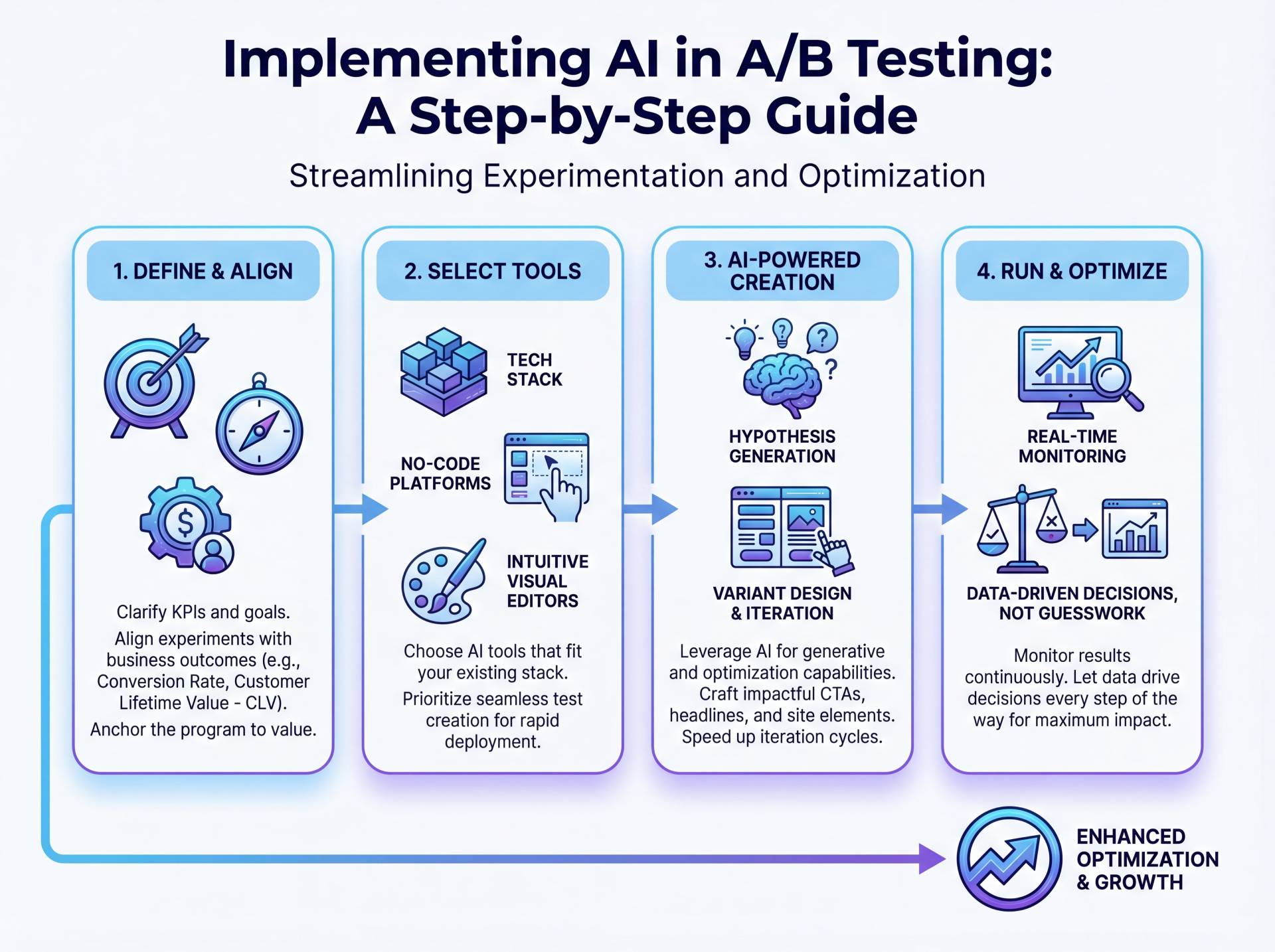
Adopting AI in A/B testing can streamline experimentation and optimisation. This usually begins by identifying where AI adds the most value, alongside clearly defined KPIs and objectives.
These tie experiments directly to business outcomes such as conversion rate or customer lifetime value (CLV).
Tools should fit your existing tech stack, with many teams using no-code platforms and visual editors to simplify test creation. AI can also assist with hypothesis generation and variant design, helping speed up iteration cycles.
Teams often use AI to develop CTAs, headline variations, and on-site elements, while enabling more responsive performance monitoring.
This reduces reliance on guesswork and supports more data-led decision-making.
Identifying KPIs and Goals
Establishing KPIs like conversion rate, CLV, or ARPU ensures your A/B testing is actionable and focused. These metrics anchor experiments, guiding analysis and refinement.
Regularly review KPIs for continued alignment with business priorities, keeping experimentation relevant and results meaningful.
Selecting the Right AI Tools
Choose AI tools that fit your needs. Look for platforms that offer flexibility, automation, and integration with existing systems.
No-code options and AI co-pilots can make testing more accessible, empowering teams of any technical background. AI assistants streamline analysis, automate hypothesis development, and drive smarter testing.
Designing and Executing AI-Powered Variations
Leverage AI for variant creation, from smart CTAs to data-backed headlines and UX tweaks. Generative AI allows teams to test multiple variants at scale, targeting segments with personalized experiences. Real-time insights support rapid adjustments, which can make your marketing more responsive and effective.
Monitoring, Analyzing, and Iterating
AI simplifies ongoing monitoring and analysis, helps identify higher-performing variations and suggests optimizations.
Focus on statistical significance and actionable metrics, using insights to refine and improve future tests. Iteration is key to continuous improvement; let data guide enhancements and strategy pivots.
Overcoming Challenges in AI-Driven A/B Testing
Despite its advantages, AI-driven testing comes with hurdles. Data quality is essential; poor inputs risk skewed outcomes. Ensure robust data governance and compliance, particularly with regulations such as GDPR, to protect data integrity and user trust.
Human oversight remains vital. AI should supplement, not replace, your judgment. Strategic alignment and context, especially regarding brand voice and ethics, require a human touch.
Common Pitfalls and How to Avoid Them
Avoid over-reliance on AI; automated models still need human intuition. Keep results and recommendations aligned with current business goals, and invest in team training to interpret AI outputs effectively.
This blend of AI insights and human expertise ensures sound, strategic decisions, explored in detail in our post on AI and human collaboration.
Ensuring Quality and Compliance
Strong data governance and ongoing audits are important for quality and compliance.
Stick to ethical guidelines, enforce data privacy laws, and maintain transparency in AI processes. Embedding these values keeps your AI testing reliable and trusted. Explore more on AI ethics.
Future Trends in AI and A/B Testing
AI is shifting A/B testing into a new era of continuous improvement, and autonomous optimization is becoming increasingly important.
Predictive analytics, large language models, and real-time AI agents empower more personalized and data-driven marketing.
Build a culture that supports experimentation, data-driven decisions, and new technology.
Emerging Technologies and Their Impact
Autonomous AI agents and LLMs can interpret and act on data in near real time, supporting cross-channel experiments and personalized campaigns. The ability to analyze and respond to data in real time increases both efficiency and marketing effectiveness.
Preparing for the Future
Organizations should consider adopting AI-driven experimentation and adaptability. Align tech progress with business vision, advocate a learning culture, and ensure teams are prepared to leverage AI fully. The goal: continuous, informed innovation to meet ever-changing customer expectations.
Conclusion
AI-assisted A/B testing is changing marketing through more intelligent experimentation. By using AI, marketers can automate parts of routine work and gain deeper insights, supporting smarter engagement and improved customer experiences.
Faster, data-driven iteration can enable near real-time optimization in some cases and help organizations stay competitive.
AI can enable faster results, deeper insights, and more scalable personalization. Continuous refinement supports more responsive marketing and can improve business performance while reducing uncertainty.
Using AI can make marketing more efficient, precise, and customer-focused. AI analytics and automation support more informed decisions and faster adjustments, helping strengthen customer engagement and business performance.