AI for Back-Office Automation and Efficiency
applied | 1 September 2026
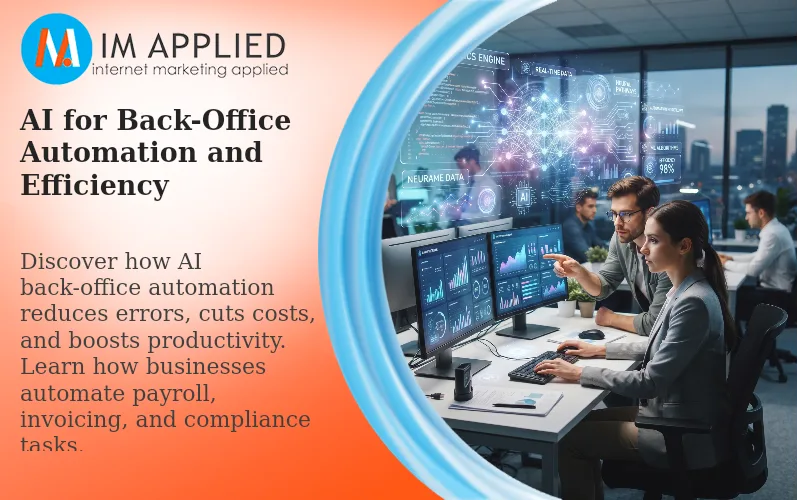
Artificial Intelligence is transforming back-office operations across many organizations. These areas handle essential tasks like data entry, payroll, customer service, and compliance management.
Traditionally, these operations have been time-consuming and prone to human error. Integrating AI reduces errors and speeds up processes that once demanded significant manual effort.
AI tools handle repetitive and monotonous tasks with precision, freeing employees to focus on work that requires human insight and creativity. Operational costs fall, and productivity rises.
As businesses seek to stay competitive, AI-driven back-office automation offers a practical path to sustained efficiency and better service delivery.
Understanding AI’s Role in Back-Office Automation
AI’s ability to analyze large volumes of data quickly is one of its core strengths. Back-office tasks like payroll processing and compliance checks typically involve managing vast quantities of information.
AI solutions sort and interpret these data sets, flagging inconsistencies or potential issues far faster than manual checking.
Consider employee onboarding, which often requires tedious data entry and document verification. AI automates the extraction of data from scanned documents and integrates it into existing databases. Onboarding time shortens and errors caused by manual data input drop substantially.
In customer service, AI-driven chatbots handle routine inquiries and issue resolutions, freeing human representatives to manage more complex situations. AI algorithms process past interactions to provide personalized responses, making service delivery more efficient.
AI also supports compliance by continuously scanning and analyzing relevant regulations and policies. Companies stay updated with regulatory requirements and avoid penalties without relying on manual monitoring.
Key Benefits of AI in the Back Office
Enhanced Efficiency
AI automates repetitive tasks, producing significant time savings. Data entry is completed faster, and payroll processing no longer bottlenecks operations. Companies that have adopted AI report increased operational speed and fewer delays.
Invoice processing is a clear example. Businesses deal with numerous invoices that need timely approval and payment. AI systems verify invoice data automatically, matching it against purchase orders, cutting payment processing time and eliminating late fees.
Cost Reduction
With AI managing routine tasks, companies reduce staffing costs. Rather than building large teams for basic work, businesses concentrate their workforce on roles that require human creativity and decision-making.
AI-powered accounting systems perform reconciliations and detect anomalies, reducing the need for additional accounting clerks.
AI also cuts the cost of data errors. Mistakes in payroll processing can trigger overpayments or compliance fines. Automated systems apply consistent accuracy, keeping those financial risks in check.
Improved Decision-Making
Accurate, timely data from AI-driven back-office functions gives managers a sharper basis for decisions. Predictive analytics can anticipate market trends or customer needs, providing businesses with a strategic advantage. Automated reports surface insights that would take human analysts far longer to compile.
In human resources, AI tools analyze employee performance data and highlight areas for training or development. Managers use these findings to target specific skills gaps with focused training programs.
Increased Security and Compliance
AI systems protect sensitive company data and keep security protocols current against evolving threats. Automated updates apply new security measures without waiting for manual review cycles.
On the compliance side, AI tracks regulatory changes and applies them to company policies without delay. Financial institutions maintain adherence to complex regulations without constant manual checks. Speeds up compliance work and cuts the rate of human error, making regulatory breaches less likely.
Challenges in Implementing AI for Back-Office Automation
Integration with Existing Systems
A primary challenge is connecting AI solutions to existing systems. Legacy systems, which many businesses still depend on, may not be compatible with advanced AI technologies.
This incompatibility can block adoption and often forces companies into costly system upgrades or custom solutions to bridge the gap.
Talent and Skills Gap
Implementing AI requires a workforce skilled in AI technologies. A shortage of professionals with the expertise to manage and maintain these systems currently makes that difficult. Businesses must invest in upskilling current employees or hiring new talent, both of which carry significant costs and take considerable time.
Data Privacy Concerns
AI systems rely heavily on data, including sensitive customer and employee information. Companies must ensure their AI implementations comply with data protection regulations. Requirements for strong data encryption and comprehensive data governance policies add complexity to AI integration.
Resistance to Change
Employee resistance to new technologies presents another barrier. Staff may fear job loss due to automation, while managers might hesitate to disrupt existing workflows.
Organizations need thorough change management strategies, including education and transparent communication, to address these concerns and build genuine support for AI adoption.
Best Practices for Implementing AI in Back-Office Operations
Conduct a Thorough Needs Assessment
Before implementing AI, businesses should evaluate their current operations in detail. Identifying inefficiencies and pinpointing where automation would have the greatest impact guides the selection of AI tools that fit the organization’s specific needs.
Pilot Programs
Starting with pilot programs lets businesses test AI solutions in a controlled environment. Challenges surface early, and adjustments happen before full-scale rollout. Concrete results from pilots also build the internal case for broader adoption.
Employee Training and Engagement
Investing in employee training is crucial. Staff need to understand how AI tools work and how those tools benefit their day-to-day roles.
Training programs should demystify AI and show how it complements rather than replaces human work. Employees who feel informed are far more likely to use the technology to its full potential.
Strong Data Management
High-quality data underpins successful AI integration. Companies should confirm their data is clean, organized, and accessible before AI systems go live. Regular data audits maintain integrity and accuracy over time.
Continuous Monitoring and Feedback
Monitoring AI system performance consistently reveals where improvements are needed. End-user feedback is critical to refining AI tools so they fit operational realities. Businesses should establish feedback loops and clear performance metrics to evaluate AI efficiency on an ongoing basis.
AI Tools for Back-Office Automation
Several AI tools target back-office work directly. RPA (Robotic Process Automation) platforms like UiPath and Automation Anywhere automate transactional processes such as customer data updates and invoice processing.
They connect well with existing IT systems, making them a practical entry point for businesses new to AI adoption.
Machine learning platforms like TensorFlow and PyTorch offer customizable solutions for processing large data sets and building predictive models. These platforms automate tasks such as financial forecasting and supply chain optimization, with models tuned to specific business needs.
For customer service, platforms like IBM Watson provide AI-driven chat interfaces that handle queries and support tasks. As these tools grow more capable, businesses that adopt them gain compounding advantages in accuracy and operational output.
Conclusion
AI adoption in back-office functions is accelerating, and the organizations that move early tend to build lasting advantages. As AI tools grow more capable, they will take on increasingly complex tasks beyond simple data entry or document sorting. Predictive analytics, for instance, will allow finance teams to model cash flow scenarios in real time rather than waiting for end-of-quarter reports.
Employees benefit too. When AI absorbs the repetitive, low-judgment work, staff can focus on decisions that actually require human experience and context. That shift tends to improve job satisfaction and reduce turnover in roles that once felt purely administrative.
One area to watch is AI’s growing role in audit preparation. Pulling together compliance documentation has traditionally consumed weeks of staff time. AI can compile, cross-reference, and flag gaps in that documentation in a fraction of the time, and with far fewer errors.
Integration with existing enterprise systems is also becoming smoother. Early AI tools often required significant IT infrastructure changes. Newer solutions connect more readily with standard ERP and HR platforms, lowering the barrier to adoption for mid-sized organizations that lack large technology budgets.
The organizations that will see the greatest gains are those that treat AI as a working partner in operations rather than a one-time cost-cutting measure. Setting clear performance benchmarks, regularly auditing AI outputs, and investing in staff training will determine whether the technology delivers sustained value or adds complexity.