
Enhancing Service Teams with AI Scheduling & Capacity Planning
applied | 24 July 2026
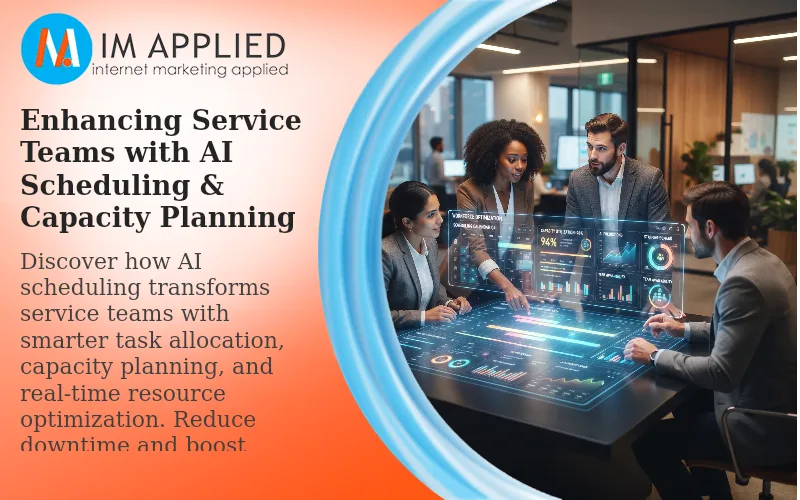
Artificial intelligence has become a crucial element in transforming how service teams operate. The growing adoption of AI for scheduling and capacity planning marks a significant shift toward more efficient service management.
Advanced algorithms and data analysis now optimize how tasks are assigned and resources are managed, letting teams respond dynamically to changing demands while cutting downtime.
AI tools can help service companies detect potential resource shortages, respond to customer inquiries faster, and plan workforce needs more precisely. Companies are increasingly integrating AI tools into their management frameworks to keep pace with these trends.
Benefits of AI Scheduling for Service Teams
AI transforms how tasks are prioritized and time is allocated, with efficiency gains among the most measurable outcomes. AI systems analyze large amounts of data quickly, letting teams optimize work schedules with precision.
Algorithms detect patterns in workflow and suggest when to schedule tasks or projects, reducing idle time and resource wastage. Teams can then focus on high-priority tasks without unnecessary delays.
Smarter decision-making is another direct result. AI offers insights that guide managers in making informed choices about task assignments. By assessing variables such as employee skills, availability, and workload,
AI tools suggest the most suitable team members for specific tasks. This targeted approach can reduce manual scheduling errors and improve service delivery. Real-time schedule evaluation also gives teams the ability to adapt quickly when unexpected changes arise.
How AI Enhances Capacity Planning
AI tools excel at optimizing resource allocation and predicting capacity needs, both critical to successful service management.
Real-time data analysis sits at the core of this capability. AI algorithms monitor current capacity levels, task progress, and resource availability, allowing teams to adjust operations dynamically. This can help teams maintain stronger performance during periods of peak demand.
Forecasting and predictive modeling add a second layer of value. AI systems use historical data to predict future demand trends, helping managers plan for upcoming challenges.
Teams can anticipate required resources well ahead of time and help prevent shortages or overloads. Managers tailor resource allocation to meet expected demands, eliminating bottlenecks and cutting response times.
Implementing AI Solutions
Introducing AI solutions into a service team requires careful planning. The first step is choosing the right tools. Businesses should assess their specific needs and identify software that aligns with their goals.
Key factors include user-friendliness, integration capabilities with existing systems, and scalability. Reliable support and suitable customization options can contribute to long-term success.
Training and onboarding determine how much value teams extract from new tools. Investing time in structured training sessions gives employees the working knowledge to use AI tools effectively.
Interactive workshops and tutorials help staff grow comfortable with new systems and get the most from them. Continuous support and feedback loops further embed AI tools into daily workflows.
Challenges and Considerations in AI Integration
AI offers real advantages, but service teams face genuine obstacles during integration. Data security and privacy rank among the most serious concerns.
Sensitive information requires strong security measures to prevent breaches and unauthorized access. Encrypting data and enforcing access controls protect confidentiality and keep organizations compliant with regulations.
Cost and resource allocation present practical constraints. Implementing AI solutions can demand significant investment in technology and training.
Organizations must weigh these costs against the expected return, justifying expenditure through measurable gains in operational efficiency and service quality. Phased implementation and careful budgeting help manage expenses without straining existing resources.
How AI Scheduling Improves Operations Across Industries
Organizations across logistics, customer service, and facilities management have adopted AI scheduling tools and seen concrete improvements in how their operations run.
In logistics and customer service, real-time scheduling systems have optimized delivery routes and cut response times, producing measurable gains in customer satisfaction and operational efficiency.
Facilities management teams have put AI to work on predictive maintenance, analyzing equipment performance data to forecast failures and schedule repairs before problems occur. These systems can reduce downtime and maintenance costs when supported by reliable equipment data and effective implementation.
Treating AI integration as a deliberate operational strategy can support more consistent and durable improvements.
Conclusion
AI’s role in service management continues to expand, with adoption accelerating across scheduling and capacity planning functions. Future trends point toward more precise scheduling tools and increasingly sophisticated forecasting models.
Businesses aiming to stay competitive should move toward AI solutions before the performance gap between early adopters and slower-moving competitors widens. For service teams, the core case is straightforward: AI integration raises efficiency, sharpens decision-making, and makes better use of available resources.
As the technology matures, its applications in service management will multiply, giving organizations more ways to improve outcomes across every part of their operations.