How Predictive Lead Scoring Can Transform SMEs Sales Strategy
applied | 27 July 2026

Predictive lead scoring uses data and algorithms to forecast which potential customers are most likely to convert.
Sales teams gain the ability to prioritize leads by purchase probability, directing resources toward the opportunities most worth pursuing. For SMEs, predictive lead scoring can significantly improve sales processes and marketing efforts.
Introduction to Predictive Lead Scoring
Traditional lead scoring relies on subjective judgment, but predictive models use data analysis and machine learning to assess leads against a wide range of variables, producing more accurate scores.
The difference in output quality is substantial, particularly for SMEs where every sales hour counts.
Ranking leads effectively is crucial for maximizing sales efforts and resources. Limited sales teams often need to do more with less, and predictive lead scoring helps by pinpointing the prospects most likely to result in sales.
Directing energy toward the highest-value opportunities raises conversion rates and improves return on investment.
A systematic approach to evaluating leads also allows businesses to operate more strategically in a competitive market.
Marketers gain the ability to target segments with the highest conversion potential, reducing wasted spend on low-probability contacts. Customer acquisition improves when sales resources go where they are genuinely needed.
How Predictive Lead Scoring Works
Predictive lead scoring relies on collecting and analyzing extensive data to predict lead quality. Various data sources feed the process, including demographic information, behavioral data such as website interactions, and historical sales data.
Together, these inputs build a comprehensive profile of both the ideal customer and individual leads.
Machine learning algorithms sit at the core of every predictive model, identifying patterns and correlations within the data to score leads by their likelihood of conversion.
These models can be retrained as new data becomes available, allowing their predictions to adapt to changing conversion patterns, although regular monitoring is still needed to maintain accuracy. That adaptability is particularly valuable for SMEs that need to stay agile.
Techniques such as regression analysis and decision trees allow models to evaluate numerous variables and uncover relationships that may be difficult to identify through manual review.
Predictive models surface subtleties in lead engagement that signal readiness to purchase, and help teams identify promising leads that might otherwise receive insufficient attention.
Benefits of Predictive Lead Scoring for SMEs
Focusing on high-quality leads allows sales teams to allocate time and resources more effectively, producing higher conversion rates.
Teams spend more time closing deals than chasing unlikely prospects, which matters most for businesses with limited sales personnel.
Identifying valuable prospects earlier also strengthens the return on investment from marketing. Campaigns tailored to resonate with high-probability leads, whether through targeted email sequences or personalized content, cut spending on broad-based tactics that deliver lower returns.
Reviewing scoring results alongside campaign and conversion data can help businesses identify which approaches perform best across different customer segments.
Less successful efforts get phased out in favor of high-potential activities, and marketing strategies grow more effective with each cycle. That iterative improvement drives both short-term conversion gains and long-term growth.
Implementing Predictive Lead Scoring in an SME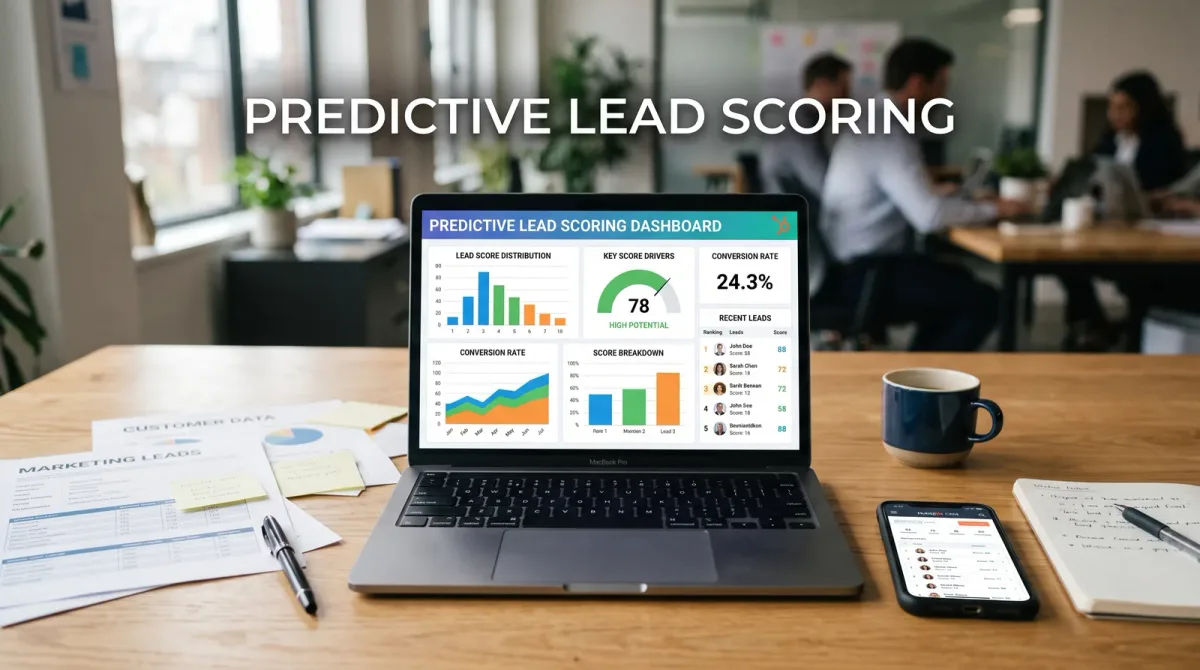
Choosing the right tools is pivotal. Software options range from standalone scoring tools to comprehensive CRM systems.
SMEs should evaluate each option against criteria including scalability, integration capabilities, and ease of use before committing.
Connecting these tools to existing systems is the next essential step. CRM and marketing automation platforms should share data reliably to support timely analysis and updated lead scores.
SMEs should consult their IT teams or external consultants to achieve smooth integration without disrupting current operations.
Team training deserves equal attention. Employees need to understand how to interpret scoring results and incorporate them into daily workflows.
Adequate training reduces hesitation toward new technology and builds a culture where data informs every sales and marketing decision.
Challenges and Considerations
High-quality data is foundational to accurate predictive lead scoring, and this is where many SMEs run into difficulty. Incomplete or inconsistent data skews scoring results.
Investing in data cleansing and validation addresses these problems before they undermine the reliability of the model’s output.
Cost and resource allocation present a separate set of obstacles. Sophisticated scoring systems can be expensive, and smaller enterprises may find the upfront investment daunting.
Starting with scalable solutions designed for SMEs keeps costs manageable, and running small pilot projects lets businesses assess real benefits before committing fully.
Selecting the right tool from a crowded market requires careful research. A solution must align with both business goals and operational workflows.
Setting clear objectives and measurable success metrics from the outset makes it far easier to evaluate whether a chosen approach is delivering results and where adjustments are needed.
Conclusion
Predictive lead scoring shifts SMEs away from guesswork and toward decisions grounded in data, raising efficiency across both sales and marketing.
High-quality data and thoughtful tool selection determine how much value the approach delivers. Team training then converts that potential into measurable results.
Artificial intelligence and machine learning will continue to sharpen predictive models in the years ahead, offering more precise lead evaluations and broader capabilities.
Monitoring those developments keeps SMEs positioned to adopt improvements as they mature. The businesses that treat lead scoring as an evolving practice rather than a one-time implementation will gain the most durable competitive edge.