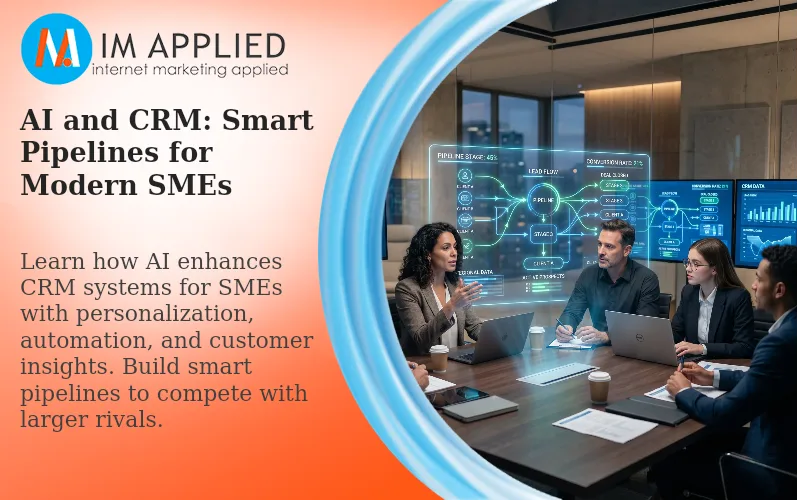
AI and CRM: Smart Pipelines for Modern SMEs
applied | 1 September 2026
Artificial Intelligence is reshaping how businesses operate by offering new ways to analyze and respond to data. At its core, AI creates systems that mimic human intelligence.
Customer Relationship Management (CRM) systems help businesses manage interactions with current and potential customers. These systems store valuable customer data, track interactions, and support marketing and sales processes.
For SMEs, understanding AI and CRM is crucial. Small and medium-sized enterprises often operate with limited resources, so they stand to gain significantly from the efficiencies and insights provided by AI-enhanced CRM systems.
These tools help SMEs better understand their customers and reduce manual operational overhead. Applying AI and CRM technologies allows SMEs to compete with larger rivals by creating personalized experiences and improving customer satisfaction.
The Role of AI in Modern CRM Systems
AI adds significant value to CRM systems by boosting their functionalities and outcomes with advanced features and capabilities.
AI-Driven Personalization
Personalization sits at the forefront of modern customer experiences. AI allows businesses to tailor interactions based on customer preferences and behaviors.
An AI-driven CRM system can analyze vast amounts of data to segment audiences and personalize messages, building stronger customer relationships through more relevant communication.
Improved Customer Insights
Deeper insights into customer behavior are essential for growth. AI can sift through complex data sets to provide actionable insights. Armed with this intelligence, SMEs can anticipate customer needs and adapt strategies quickly.
Automation and Efficiency
Automation is a significant advantage AI brings to CRM systems. Routine tasks such as data entry, lead scoring, and follow-up reminders can be automated, freeing up valuable time for sales and marketing teams to focus on building meaningful customer relationships.
Building Smart Pipelines
Creating an AI-enhanced CRM pipeline involves strategic planning and execution.
Assessing Business Needs
Before implementation, assess current business needs. Determine which CRM functions are essential and identify where AI can have the most impact, such as lead management or customer service.
Choosing the Right AI Tools
Selecting the right AI tools is crucial. Evaluate different platforms and solutions that align with business goals and budget constraints. Look for tools that offer scalability and integration capabilities with existing systems.
Integrating AI with CRM
Compatibility between AI tools and the current CRM system must be confirmed before integration begins. Every necessary function should be supported once the systems are connected, and data must flow consistently across all platforms.
Benefits of AI-Enabled CRM Pipelines for SMEs
Scalability
AI-powered CRM systems scale with the business. As the enterprise grows, the CRM can handle increased data and customer interactions without sacrificing performance, supporting long-term growth.
Cost-Effectiveness
AI can optimize resources and reduce costs. By automating routine tasks and surfacing customer insights, SMEs can allocate resources more efficiently and cut unnecessary expenditures.
Improved Customer Relationships
Strong customer relationships are vital for any business. AI-enhanced CRM systems enable more personalized customer experiences, fostering loyalty and satisfaction. Longer customer lifecycles and increased positive word-of-mouth follow from that deeper engagement.
Overcoming Challenges in AI and CRM Implementation
Implementing AI and CRM in SMEs can present challenges, but strategic planning can address each one.
Data Privacy Concerns
Data privacy is a significant concern. SMEs must maintain compliance with data protection regulations and employ strong security measures to protect customer information.
Skill Gaps
Not all SMEs have in-house expertise in AI technologies. Providing training or hiring skilled professionals can bridge this gap, so the tools are used to their full potential.
Integration Issues
Integrating AI with existing systems can be challenging. SMEs should seek solutions with proven integration capabilities and dedicated support to resolve compatibility issues.
Conclusion
AI-driven CRM systems give SMEs a practical way to compete on personalization, speed, and customer intelligence without requiring the budgets of larger organizations. Training staff and confirming system compatibility before deployment prevents the most common implementation failures.
The case studies above show measurable results are achievable within months, not years. SMEs that commit to this integration now build the operational foundation needed for sustainable growth.