How AI Streamlines Your Marketing Workflow
applied | 27 August 2026
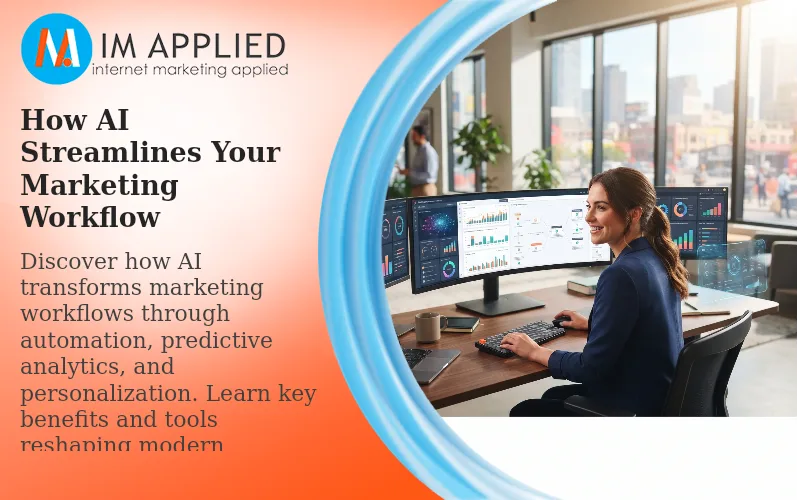
Artificial intelligence is transforming how marketers operate, from automating routine tasks to surfacing deep insights into consumer behavior. Processing vast amounts of data quickly frees marketers to focus on creativity and strategy.
Brands that adopt AI connect with their audiences more precisely and see measurable gains in engagement and sales.
Understanding AI in Marketing
Marketers once relied heavily on manual data analysis to shape their strategies. As AI technologies matured, the ability to analyze large datasets and surface actionable insights quickly changed how campaigns are built and refined.
Machine learning, a subset of AI, fine-tunes algorithms over time, making marketing efforts more precise and effective.
Key Benefits of AI in Marketing Workflows
Automation of Repetitive Tasks
AI excels at automating mundane tasks that consume valuable time. These include scheduling social media posts, responding to customer inquiries through chatbots, and managing email marketing campaigns.
Removing these from marketers’ plates lets teams shift focus to strategic work that requires human creativity and intuition.
Enhanced Data Analysis and Insights
AI can sift through large volumes of data and identify trends far faster than manual methods.
Marketers gain insights into customer behaviors and preferences almost instantly, which makes it practical to build targeted campaigns that resonate with specific audience segments.
Personalizing the customer journey at scale becomes achievable when AI handles the underlying analysis.
AI Tools Transforming Marketing Practices
AI-Powered Content Creation Tools
Content generation tools use AI to draft articles, social media posts, and video scripts, enabling marketers to produce high-quality content at scale.
By analyzing existing content and predicting which topics will engage audiences, these tools help maintain a consistent brand voice while pushing approaches to content creation in new directions.
AI-Driven Customer Segmentation Tools
AI segmentation tools analyze demographic, behavioral, and transactional data to divide consumers into meaningful groups.
Marketers can then tailor messaging and offers to specific segments, optimizing campaigns and improving conversion rates. Tighter targeting means marketing resources go where they are most likely to produce results.
Challenges and Considerations
Data Privacy Issues
One of the most pressing challenges is data privacy. The collection and processing of personal data by AI technologies have raised serious concerns about protection and consent.
Companies must comply with regulations like CCPA and GDPR, ensuring consumers’ data is safeguarded and used transparently. Failing to address these concerns can lead to legal repercussions and lasting damage to consumer trust.
Ensuring Accurate AI Implementation
Correct implementation is equally critical. Inaccurate data input or misconfigured algorithms produce flawed insights that distort marketing outcomes.
Organizations need trained professionals who understand AI technologies to implement and manage these tools, maintaining the accuracy and reliability of the insights they generate.
The Future of AI in Marketing Workflows
Emerging AI Trends
Advances in natural language processing and augmented reality are opening new opportunities for marketers.
AI systems are increasingly capable of understanding and generating human language, making them more effective at interacting with consumers in a personal, context-aware way.
Potential Developments on the Horizon
AI systems may integrate more closely with technologies like blockchain, adding security and transparency to transactions.
Real-time personalization and adaptive content that adjusts based on live user interaction are also set to grow, pushing the degree to which individual consumer experiences can be shaped on the fly.
Conclusion
Integrating AI into marketing workflows gives businesses a genuine competitive edge. Automated handling of repetitive tasks, faster and deeper data analysis, and sharper audience targeting all translate into measurable operational gains.
Marketers who stay informed about emerging AI capabilities and invest in proper implementation will be best positioned to turn those gains into sustained growth.