
AI Tools for Detecting Conversion Drop-Offs
Karl Marais | 29 January 2026
Most businesses focus on driving traffic, but traffic alone doesn’t drive revenue. What matters is what happens after users arrive, where they hesitate, drop off, and fail to convert. AI tools can help you identify those friction points and fix them at scale. Here’s how.
The Importance of Analyzing Conversion Drop-Offs
Analyzing conversion drop-offs is crucial for maximizing digital marketing effectiveness. Examining where and why potential customers abandon your funnel, whether due to user experience issues or technical errors, helps you identify friction points and address them with smart strategies. This type of insight drives better conversion rate optimization (CRO), enhances the customer journey, and boosts returns on your investment.
Understanding Conversion Rates
Conversion rates are a key performance indicator that shows the percentage of users who complete a desired action. Knowing your funnel’s conversion rates, by applying industry benchmarks and using the right formulas, lets you spot both strengths and weaknesses. Track both micro-conversions and macro-conversions to gain actionable insights, set realistic objectives, and optimize performance.
Common Causes of Conversion Drop-Offs
Why do customers drop off? Common culprits include:
- Website friction: Slow pages, confusing navigation, or unresponsive elements
- Checkout process issues: Frustrating forms or hidden charges
- Poorly designed CTAs: Ineffective calls-to-action can reduce conversions
- Technical errors: Bugs or glitches hinder completion
Tools like form analytics and heatmaps help pinpoint and address these issues, paving the way for smoother user experiences and higher conversion rates.
Impact of Conversion Drop-Offs on Business Performance
High drop-off rates reduce sales, increase customer acquisition costs (CAC), lower customer lifetime value (CLV), and hurt your overall ROI. Consistently monitoring these metrics helps you adjust strategies and safeguard revenue. For a deeper dive, see
Advantages of Using AI for Conversion Analysis
Integrating AI into conversion analysis brings significant advantages:
- Actionable insights: AI detects patterns and anomalies, enabling rapid response
- Business intelligence: Data-driven decisions become the norm, not the exception
- Marketing automation: AI streamlines processes and boosts efficiency
AI empowers you to understand customers, segment users, and personalize communications, improving your sales funnel performance and giving you a competitive edge.
How AI Improves Conversion Insights
AI analyzes large datasets to identify the root causes of conversion drop-offs. With AI-driven segmentation and journey analysis, marketers can target interventions precisely and enhance the customer experience. Compared to basic analytics, AI delivers deeper, more actionable insights, helping you optimize resource allocation and stay ahead of trends.
The Role of Machine Learning in Conversion Analytics
Machine learning powers smarter decision-making in conversion analysis. Using predictive algorithms and models, businesses can forecast conversion trends and identify at-risk user segments. Both supervised and unsupervised learning reveal hidden patterns, enabling refined strategies and preemptive actions.
Learn about predictive analytics in marketing.
Real-Time Data Processing and Its Benefits
AI-powered real-time data processing enables marketers to get immediate feedback, allowing for rapid optimization and dynamic personalization. Real-time alerts spotlight emerging issues, so they can be addressed before they cause harm, ensuring campaigns stay effective and relevant. For more, see AI in real-time marketing.
Key Features of AI Tools for Detecting Conversion Drop-Offs
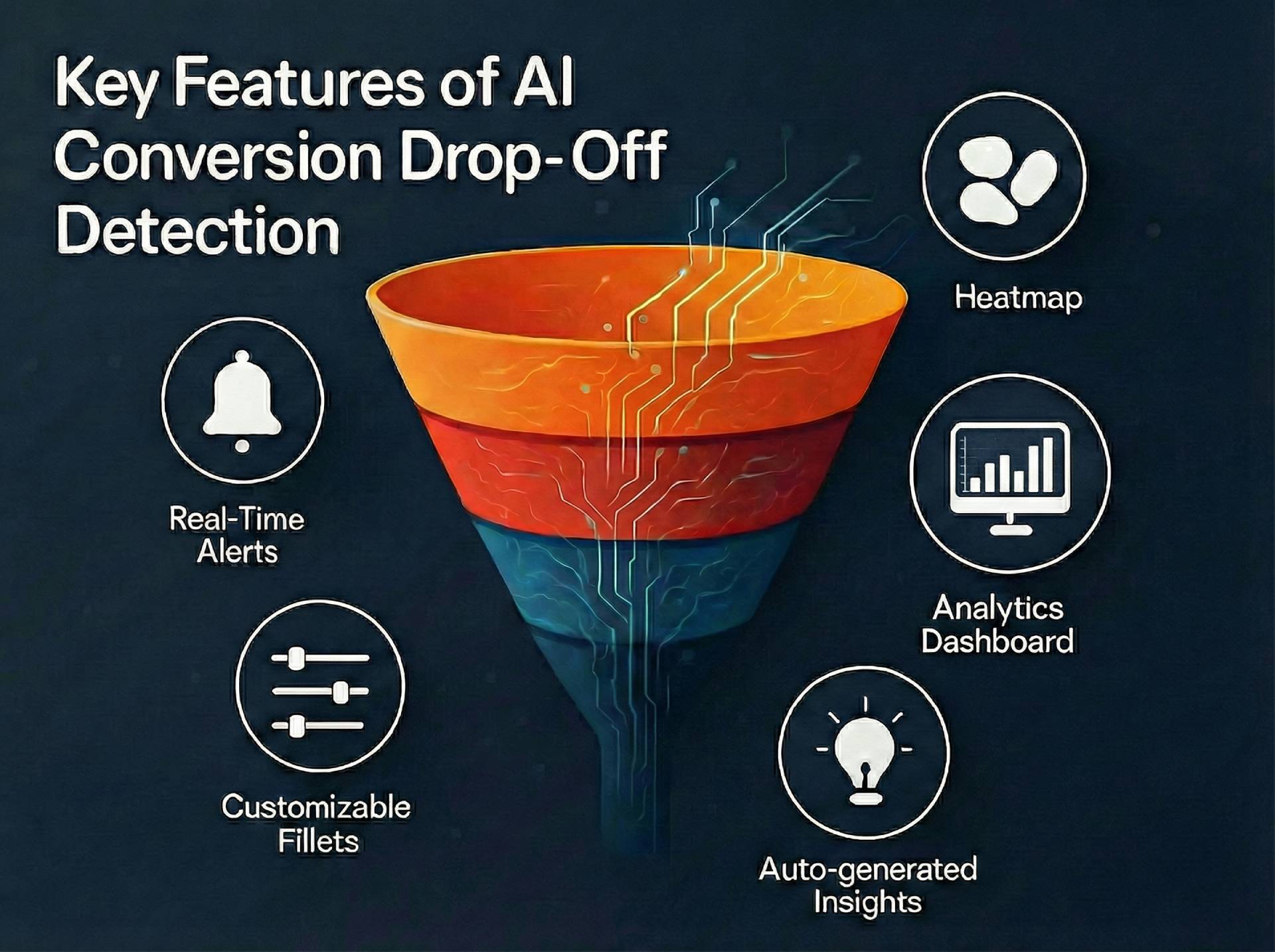
When choosing AI tools for spotting conversion drop-offs, prioritize those that:
- Integrate with existing systems for a seamless workflow
- Provide robust data visualization and actionable reporting
- Support automated processes for efficient, accurate analysis
A good foundation also involves a structure optimized for AI.
Predictive Analytics and Forecasting
AI-driven predictive analytics anticipate user behaviors, recommend strategic changes, and support targeted lead scoring. Access to rich trend data enables marketers to adapt quickly and design proactive, high-performing campaigns.
Automated Data Collection and Analysis
AI automates data collection and cross-referencing, reducing manual errors and accelerating insight delivery. With reliable, real-time updates and reports, your teams can make smarter, faster decisions.
User Behavior Tracking
AI tools offer session replays, heatmaps, and goal tracking, delivering a granular understanding of user actions. Identifying patterns like rage clicks helps tailor improvements and create conversion-friendly experiences.
Evaluating AI Tools for Conversion Analysis
To select the right AI tool:
- Compare platforms, evaluating features, reliability, and integration ease
- Check vendor support, update frequency, and track record
- Weigh technology investment against business goals and ROI
For a step-by-step selection process, see this AI tool evaluation guide.
Criteria for Choosing the Right AI Tool
Focus on scalability, integration, usability, strong customer support, and rigorous data privacy. These foundations help to ensure you’re investing in solutions that will flex with your business and stay compliant.
Comparing Top AI Solutions Available
Market research, reviews, and side-by-side feature comparisons help pinpoint the leading tools. Explore alternative solutions, as even lesser-known platforms can offer surprising value.
Cost vs. Value Considerations
Balance the tool’s value proposition against total costs, including implementation and maintenance. Premium tools might offer advanced features, but you improve ROI by matching capabilities with actual business needs.
Implementing AI Tools in Your Business

Integrating AI is like adding a turbocharger to your business. Start with a clear implementation strategy, tailored to your organization’s unique needs. Focus on workflow integration so AI augments, not disrupts, your processes, and champion change management to promote team buy-in and smooth adoption.
Steps to Integrate AI Tools
Follow these steps:
- Create a structured project plan for setup and integration
- Execute precise data migration, testing with a pilot before full rollout
- Onboard your team, ensuring comfort with the new system
Solid groundwork reduces risks and accelerates realization of benefits.
Training Teams for AI Tool Utilization
Prioritize skill development and ongoing support, tap internal tech champions, and foster a culture of continuous improvement. Well-trained teams maximize adoption and better utilize AI’s full potential.
Measuring Success After Implementation
Set clear KPIs, track conversion rate improvements, and run A/B tests to evaluate impact. Regularly review benchmarks and compare pre- and post-AI performance to monitor sustained value.
Challenges and Limitations of AI in Conversion Analysis
Despite its promise, AI brings challenges, chief among them, data quality, algorithm transparency, and bias. Poor data or overlooked bias can undermine results. Security and compliance are also essential, as missteps threaten both customer trust and regulatory standing.
Understanding AI Bias
Algorithmic bias often results from unrepresentative training data, affecting fairness and accuracy. Routine audits and diverse datasets are vital to mitigate these effects and ensure reliable insights.
Handling Large Data Sets
AI’s power depends on a robust infrastructure that can handle big data. As your information volume grows, scalable systems are a must to maintain speed and accuracy.
Overcoming Integration Issues
Successful adoption means navigating system integration, especially with legacy systems or data silos. Prioritizing seamless data flows and overcoming technical challenges can maximize the impact of your AI investment.
The Future of AI in Conversion Analytics
AI tools help businesses identify where users drop off, uncover friction in the funnel, and optimize experiences to increase conversions. By combining data, automation, and predictive insights, companies can turn lost opportunities into measurable growth.
AI in marketing is moving fast, enabling deeper, personalized insights and raising the bar for conversion analytics. Businesses that stay on top of advancements will gain more precise, scalable analysis and a sustainable competitive advantage.
Emerging Technologies and Trends
Generative AI, voice analytics, and next-level personalization are reshaping the CRO landscape. These innovations enable tailored experiences and deeper engagement, turning data into meaningful action and growth.
Long-Term Benefits of AI Adoption
Integrating intelligence into core processes drives sustainable growth, operational efficiency, and heightened customer loyalty for the long haul.
Preparing for Future Developments
To remain competitive, foster continuous learning and readiness for future tech. Embrace agile strategies and stay current on AI advances.
Use AI to turn lost opportunities into consistent conversion wins, now and into the future.