AI-Powered Market Research for SMEs
Karl Marais | 19 March 2026
AI is changing how SMEs understand their customers. With the ability to process vast datasets in real time, making it easier to identify new opportunities. But in a crowded landscape of AI tools, how do you choose the right one?
AI insights don’t replace human expertise; they amplify it. The real value of AI in market research is in the decisions it supports, keeping you ahead in today’s fast-evolving market.
Introduction to AI-Powered Market Research
AI-powered market research gives SMEs a practical advantage. AI analyzes data to uncover patterns in consumer behaviour. This real-time capability helps SMEs make informed, competitive decisions and spot emerging trends.
By fusing technology and human insight, businesses can anticipate market shifts and thrive against larger competitors.
Defining AI Market Research Tools
AI market research tools automate processes, generate deep insights, and streamline analytics.
These platforms process consumer feedback at scale, minimize human error, and accelerate decision-making. Advanced solutions handle unstructured data, transforming it into actionable insights.
With these tools, businesses can turn raw data into usable insights for decision-making, aligning offerings more closely with market demand.
Key Concepts and Terminology
Understanding the basics, such as Natural Language Processing (NLP), Machine Learning (ML), and predictive analytics, makes it easier to work with AI-driven market research.
AI algorithms perform sentiment analysis, learn from patterns, and can generate synthetic or augmented datasets. T
ools powered by deep learning and large language models (LLMs) spot subtle consumer nuances that traditional analytics might miss. Learn more in Why Predictive Analytics Should Be Part of Every Marketing Strategy.
The Role of AI in Modern Market Research
AI is changing market research by helping businesses interpret massive datasets with efficiency. Companies can now uncover behavioral patterns and quickly adapt strategies based on real-time insights.
As manual labor decreases, researchers can focus more on strategy and innovation, making businesses more agile and competitive.
How AI Transforms Data Collection and Analysis
AI automates tedious data gathering and processing tasks. Techniques such as web scraping and social media monitoring provide useful insights from various sources.
Automated processes mean quicker, more accurate analysis, enabling businesses to understand consumer trends in real time. To advance your digital approach, visit digital marketing strategy vs digital marketing tactics.
Enhancements Over Traditional Methods
AI delivers speed and accuracy, reducing human error and freeing up researchers to focus on strategic thinking. With scalable systems, vast datasets can be processed effortlessly, giving rise to more robust results than human-only methods.
Real-time Data Insights
With AI, businesses gain live dashboards and instant access to key metrics, critical for reacting quickly in fast-moving markets.
Real-time analytics help companies act while events unfold, making businesses more responsive. For SMEs, these capabilities translate into clear business advantages. Learn more in real-time marketing.
Benefits of AI for SMEs in Market Research
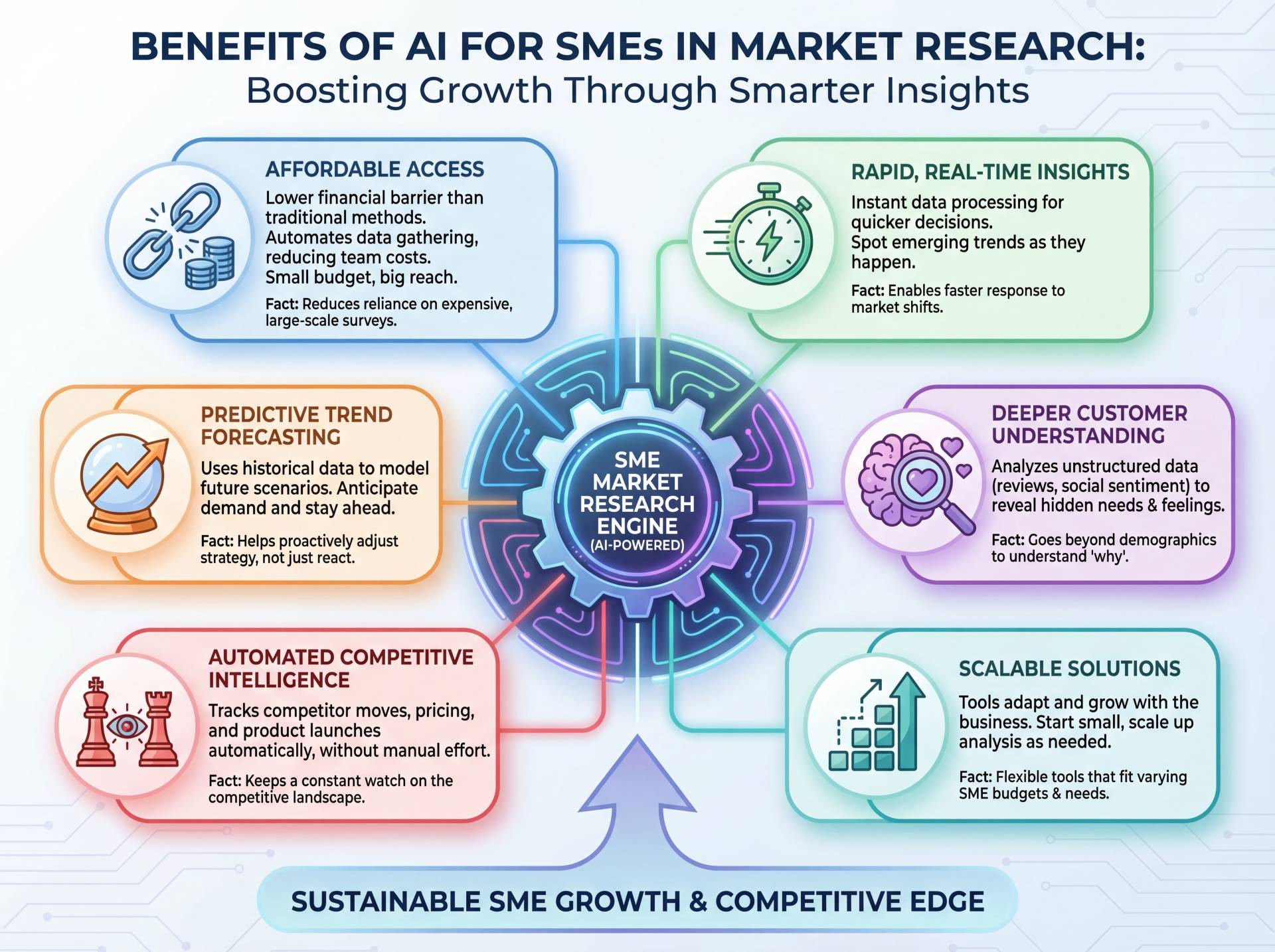 For SMEs, AI offers a distinct advantage by giving access to more detailed insights with fewer resources. AI-powered tools give small businesses access to analytics once reserved for large enterprises.
This can lead to better market targeting, efficient go-to-market strategies, and sustainable growth.
AI not only streamlines data analysis but also helps SMEs identify trending opportunities and optimize their offerings.
Scalable platforms keep small businesses agile and responsive in changing markets. Learn more in AI SEO for Small Businesses Success.
Tailored Insights for Small Businesses
AI enables SMEs to deliver highly personalized messaging at scale. By analyzing customer data, businesses can tailor content to specific audience segments, improving relevance and engagement.
For further exploration, see Using AI to Predict Customer Behavior and Actions.
Cost Efficiency and Resource Management
AI enables cost-effective research: automating data collection, reducing manual labor, and optimizing resources.
This means SMEs can allocate budgets wisely and focus on areas that drive growth. Efficient processes lower overheads and enhance competitive standing, even against larger rivals.
Speed and Accuracy in Data Processing
Speed is critical in fast-changing markets. AI processes data quickly, providing timely, precise insights while minimizing errors. This supports strategy shifts and fosters better decisions.
Choosing the Right AI Tools for Your Business
Selecting the best AI tools means matching capabilities to your business goals. Choose solutions that offer a full suite of marketplace capabilities and are easy for your team to adopt, ensuring smooth integration into your workflow.
Evaluating Your Business Needs
Start by clarifying your objectives and key audience. Prioritize tools that fit those needs; some specialize in product feedback, others in sentiment analysis, or campaign effectiveness. Choose features that offer relevant, actionable insights.
Comparing Popular AI Market Research Tools
Leading tools include Qualtrics (survey automation), ChatGPT (NLP), GWI Spark and Brandwatch (consumer analytics), and Hotjar (UX insights).
Zappi and SurveyMonkey Genius are strong for innovative survey design. Benchmarks like these will help you select the best fit for your strategies.
Integration with Existing Systems
Ensure your chosen platform integrates with your current CRM and analytics tools to minimize data silos and streamline workflows. Robust API support is a plus for seamless operations. Optimized integration leads to better data synergy.
Implementing AI-Powered Research Strategies 
Effective AI implementation transforms workflows and operational efficiency. Start with pilot projects to gauge impact and adjust strategies. Align AI integration closely with your business goals to drive real-world benefits.
Setting Up AI Tools in Your Business
Move beyond installing software: strategically weave AI into operations. Assess your current research process and target phases AI can best support.
Roll out changes gradually, starting with small projects to enable smooth adaptation and solid resource management.
Training Your Team for Optimal Use
Upskill your team with tailored training, combining technical and real-world applications. Encourage cross-department learning to spark new ideas and foster smooth adoption. This helps you fully realize AI’s potential and maximize its impact.
Measuring Impact and ROI
Use clear metrics, like revenue, engagement, and efficiency, to monitor AI’s business impact. Regular assessment aligns strategies with outcomes, highlighting what works and where to optimize.
Addressing Challenges in AI Market Research
While AI offers significant advantages, it brings challenges, such as AI limitations tied to data quality, potential bias, and the need for human interpretation.
Responsible AI implementation is essential for amplifying business operations, not hindering them.
Ethical considerations, like job displacement or over-reliance on AI, must be managed by blending human judgment with AI outputs.
Ongoing monitoring helps mitigate risks of bias and helps ensure strategic, balanced decisions. Learn more about ethics in AI marketing.
Ensuring Data Security and Privacy
Adhere to regulations like GDPR by encrypting and anonymizing data, implementing strict access controls, and strengthening cybersecurity. Transparent communication about data use builds stakeholder trust and demonstrates your commitment to privacy.
Mitigating Bias in AI Algorithms
Tackle bias by diversifying datasets, monitoring outputs, and adjusting continuously. Use representative data to prevent skewed insights, and proactively seek out and correct bias.
Building fairness into your AI models enhances the credibility and trustworthiness of your research.
Aligning AI Insights with Human Expertise
AI’s analytical speed pairs best with human researchers’ creativity and critical judgment.
Human insight ensures AI-driven findings make practical sense and align with nuanced business realities. This synergy leads to a better, more balanced strategy.
The Future of AI in Market Research for SMEs
For SMEs, leveraging AI will be crucial to staying competitive. AI advancements promise innovations like generative analysis, deep learning, and multimodal insights, helping businesses better anticipate trends and personalise their approach.
AI’s role is to augment, not replace, human judgment, freeing up time for high-value work like strategy and innovation. SMEs adopting AI can position themselves for long-term resilience and sustainable growth.
Emerging AI Technologies
Tools like generative AI, deep learning, and large language models help SMEs dig deeper into data and simulate future market dynamics.
Multimodal analytics integrates various data types, providing richer insights and further setting proactive companies apart.
Predictions for Market Research Developments
Expect standard tools like voice and sentiment analysis to automate routine research and drive hyper-personalized strategies.
Predictive algorithms will enable businesses to anticipate changes and refine audience targeting to drive stronger engagement.
Preparing Your Business for Future Trends
Preparing means aligning strategic objectives with AI capabilities, integrating tools into your core processes, and staying flexible.
By building a culture that values innovation and adaptability, SMEs can seize opportunities and maintain market leadership in an AI-driven era.