
AI for Invoicing & Billing Automation
applied | 17 August 2026
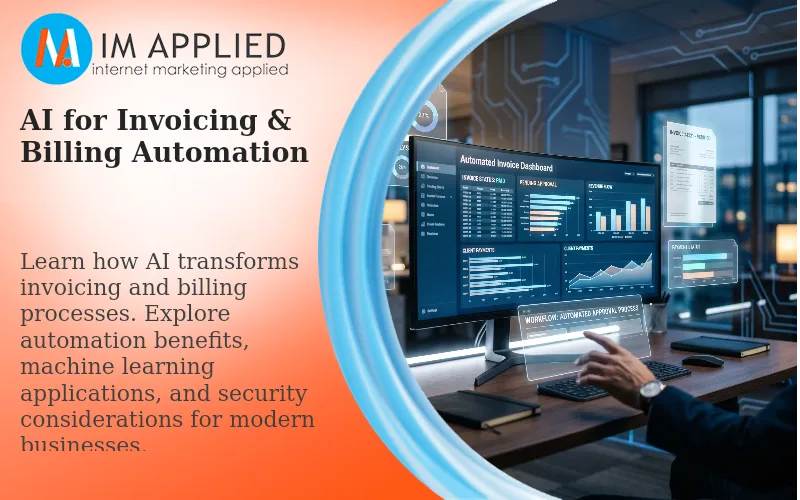
Artificial intelligence is transforming invoicing and billing processes and changing how businesses manage financial transactions. AI has become an essential tool in the financial sector.
This shift automates mundane tasks and delivers major improvements in efficiency, accuracy, and cost. Businesses that understand its applications can make more informed decisions about where and how to adopt it.
Understanding AI in Invoicing & Billing
AI-powered invoicing uses advanced algorithms to automate the creation, sending, and tracking of invoices. This technology recognizes patterns and makes data-driven decisions.
By eliminating manual data entry and reducing human error, AI offers a more efficient way to manage invoices. Businesses can automatically generate invoices based on predefined rules, apply tax calculations consistently, and automate reminders for unpaid invoices.
Common AI Technologies Used in Billing
Several AI technologies are integral to billing automation. Natural Language Processing (NLP) processes unstructured data, such as email instructions, and converts it into structured formats suitable for invoicing.
Machine learning algorithms analyze historical billing data to predict future patterns and detect discrepancies. Optical Character Recognition (OCR) scans and digitizes paper invoices, integrating them directly into digital systems without manual re-entry.
Benefits of AI for Billing Automation
One of the primary benefits of AI in billing is a dramatic increase in efficiency. Automated systems process large volumes of invoices much faster than human staff. Unlike human workers, these systems operate continuously without breaks.
AI systems handle thousands of transactions simultaneously, significantly cutting turnaround time. Faster processing means businesses get paid sooner and can redeploy staff to more strategic roles.
Billing accuracy is crucial, as errors lead to disputes and damage customer satisfaction. AI systems minimize these errors by analyzing data with precision. When invoices are generated, AI checks for consistency and flags anomalies that might indicate a mistake.
By cross-referencing information from multiple data points, AI confirms that every detail matches exactly, reducing the common errors seen in manual billing processes.
Challenges and Considerations
Data Privacy and Security Concerns
AI also poses challenges, particularly around data privacy and security. Billing information often contains sensitive data that requires protection. Implementing AI systems requires businesses to prioritize strong security measures.
Encryption, secure data transfers, and regular audits are vital in keeping sensitive information confidential. Companies must also verify that their AI vendors comply with relevant data protection regulations to guard against breaches.
Integration with Existing Systems
Another challenge is integrating AI solutions with existing business systems. Many companies run legacy software that was not designed to interact with modern AI applications. Smooth integration requires careful planning and may require significant restructuring of current systems.
Businesses must weigh the cost and effort of such integration against the potential benefits. Addressing these challenges early can prevent operational disruptions and preserve the value of the new system.
Industry Use Cases
Small businesses increasingly use AI to handle invoicing and billing tasks. AI solutions allow small firms to automate repetitive tasks, freeing time to focus on growing their operations.
AI-driven invoicing platforms automate payment reminders, track invoice status, and generate detailed reports, reducing the overhead of manual billing.
Large enterprises benefit significantly from AI in billing, given their complex needs and high transaction volumes. Enterprises use AI to predict cash flow based on current and historical billing data, optimize billing cycles, and tailor customer interactions.
The sophistication of these systems makes it possible to handle intricate invoicing tasks that would be infeasible to manage manually.
Future Trends in AI and Billing Automation
AI’s ability to predict trends points to a strong future for billing automation. Predictive analysis identifies spending patterns and forecasts future billing requirements.
Businesses can plan more strategically for future expenses and revenues, and can identify potential financial challenges before they arise.
Machine learning continues to transform invoicing systems in meaningful ways. Algorithms that learn from previous billing cycles suggest improvements and offer insights into optimizing processes further.
As these capabilities improve, systems will grow more adept at adapting to new data and offering smarter solutions that reduce human intervention while improving accuracy.
Conclusion
Efficiency gains arrive quickly when businesses adopt AI for invoicing and billing. Automated processing cuts turnaround times, flags errors before they become disputes, and frees staff for higher-value work. Those gains come with real obligations: data privacy must be protected, and integrating AI with legacy systems demands careful planning and adequate resourcing.
Real-world adoption spans the full range of business sizes. Small firms use AI to reduce administrative overhead, while large enterprises apply it to optimize cash flow forecasting and billing cycle management.
The gap between early adopters and those still relying on manual processes will widen as predictive analysis and machine learning capabilities advance.
Businesses that move deliberately on AI adoption, assessing security requirements, vetting vendors, and mapping integration paths, will be better positioned than those that treat it as a plug-and-play solution.
The technology continues to mature, and the organizations that build a disciplined foundation now will carry a measurable advantage as the tools grow more capable.