
AI-Enhanced Content Clusters: How to Build Topic Ecosystems That Rank
Karl Marais | 11 December 2025
You’ve followed SEO best practices, built your blog, and climbed a few keyword rankings.
Users now seek instant, AI-powered answers, bypassing traditional blog links, and frustratingly, your insights aren’t included.
Understanding AI-Enhanced Content Clusters
AI-enhanced content clusters have evolved beyond traditional content structures.
They create a robust content ecosystem organized around central subjects, following a hub-and-spoke model.
The pillar page (hub) is the authoritative source on a broad topic, while cluster pages (spokes) dive into related subtopics.
This architecture benefits both users and search engines by making navigation seamless and highlighting your expertise.
When executed properly, clusters boost both relevance and engagement. Pillar pages link to and from related articles, forming a cohesive, interlinked web of resources.
What Are AI-Enhanced Content Clusters?
AI-enhanced content clusters are groupings of in-depth articles centered around a single, comprehensive pillar page.
Each cluster article adds unique value, exploring different angles of the core topic and ensuring high relevance.
Interlinking these articles with the pillar page creates a strong content architecture, demonstrating thematic expertise for search engines and offering users a menu of precisely organized knowledge.
How Do AI-Powered Clusters Differ from Traditional Clusters?
AI-powered clusters employ advanced tools to surpass traditional blogging methods.
Instead of simply focusing on keyword density, AI clusters emphasize semantic SEO, understanding context, and meaning.
Automation reveals opportunities for deeper topical coverage, while AI-driven insights guide content development and reduce guesswork.
This approach uncovers opportunities that manual research might miss, resulting in stronger topical authority and better-aligned content.
The Importance of Topic Ecosystems in Modern SEO
Today’s SEO landscape is dominated by AI, requiring sophisticated strategies.
Topic ecosystems allow search engines to see content holistically, establishing your brand as a topical authority.
Modern SEO is about weaving keywords into a larger, coherent framework where content pieces reinforce one another.
AI-powered search focuses on user intent and context, not just isolated terms.
Building interconnected content enhances search visibility and user experience, ensuring comprehensive answers.
Adopting this approach keeps your content both visible and authoritative.
Why Topic Clusters are Essential for AI Optimization
This structure enables search engines to recognize topical authority.
With trends like Answer Engine Optimization (AEO) and Google’s Search Generative Experience (SGE), clusters have become important for surfacing your expertise across search features.
The Role of AI in Redefining SEO Strategies
AI has broadened SEO’s focus. Rankings are now shaped by semantic search and user intent, rather than by keyword frequency alone.
Generative AI personalizes search experiences, demanding more comprehensive content that addresses various user intents and the full user journey.
Integrating AI requires understanding its impact on the technical and content aspects of SEO.
Staying responsive to these shifts is essential for maintaining digital relevance in this fast-evolving landscape.
Mapping Out Your Cluster Structure Using AI
Once you define your core topic, visualize your cluster structure using content mapping tools.
The hub-and-spoke model features a comprehensive pillar page with linked subtopics as spokes.
Use tools like mind maps or internal link maps to build an organized, navigable site.
Focus your internal links on creating a natural, semantic network that guides users smoothly through related content.
A strategic cluster structure improves site hierarchy and allows search engines to crawl efficiently.
Optimizing Topic Clusters for Maximum Impact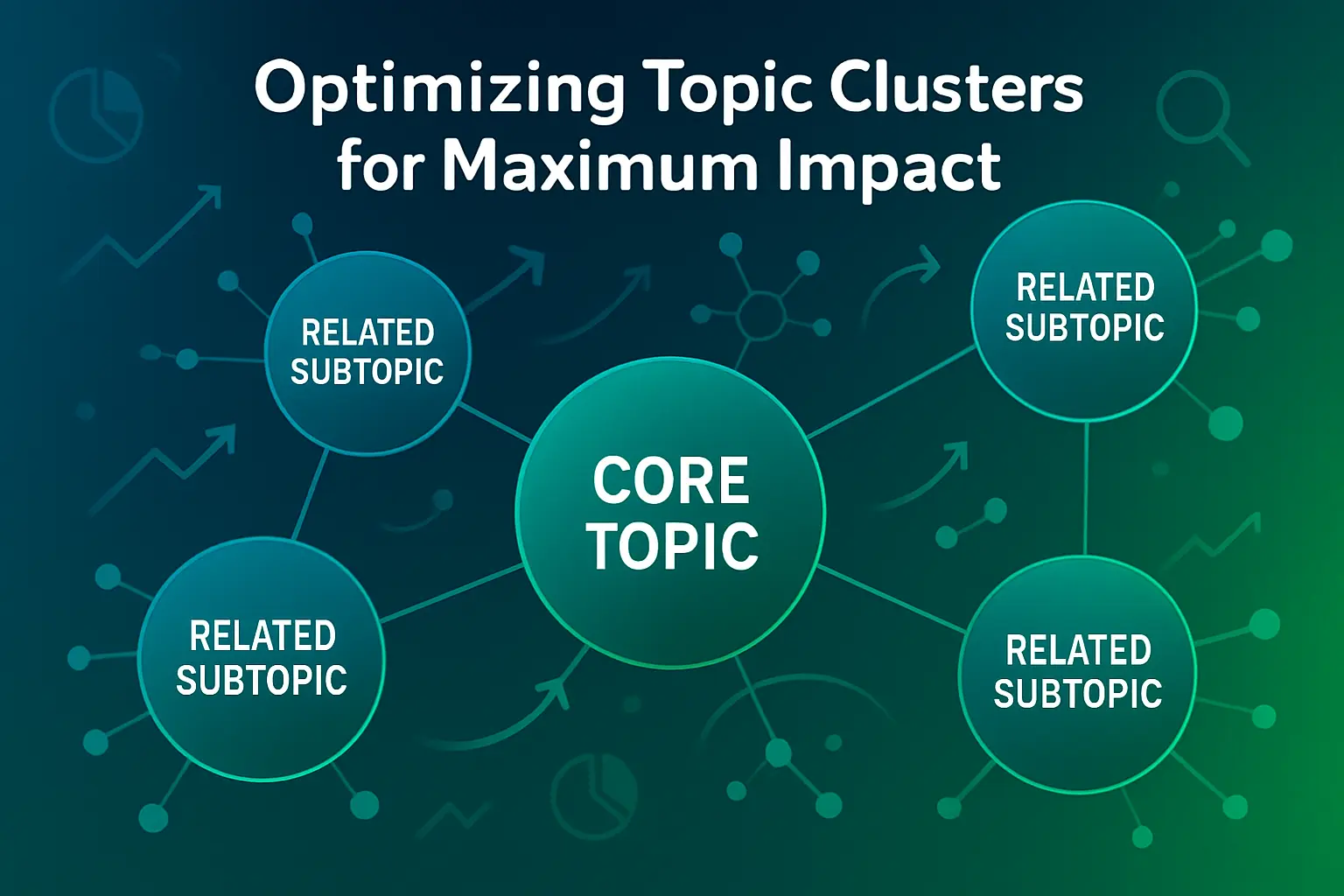
Well-structured topic clusters raise your content’s visibility as search evolves.
Review your strategy to ensure you’re identifying core topics and forming thorough clusters.
This fortifies your thematic authority and improves optimization by making information both accessible and interconnected.
For maximum impact, incorporate AEO-ready content: structure articles for easy consumption by both readers and AI.
Add schema markup and structured data to help search engines interpret your content’s context, increasing your visibility across new search channels.
Strengthen your clusters with effective internal linking to deliver a seamless user experience.
Tools and Resources for Building AI-Enhanced Clusters
Success in the modern SEO landscape hinges on the right tools. Integrating AI-powered platforms into your clustering strategy drives both efficiency and accuracy.
Top AI Tools for Content Clustering
Leading AI tools include ChatGPT, Surfer SEO, and MarketMuse.
ChatGPT excels as a writing assistant, while Surfer SEO and MarketMuse offer in-depth optimization insights.
Ahrefs and SEMrush are invaluable for keyword research and competitor analysis.
Leverage these tools to develop content that meets audience needs and strengthens the cluster.
Resources to Deepen Your Cluster Strategy
Visualization tools like Miro and Notion help blueprint and execute complex clusters.
Google Keyword Planner and Google Trends reveal trending topics and search behaviors.
SEO plugins such as Rank Math and Yoast streamline content optimization.
Consider integrating AI chatbots to gather user insights and further engage your audience. These resources help foster a strong, interconnected online presence.
Measuring the Success of Your Topic Ecosystem
Creating clusters is only the start; measuring their effectiveness is essential.
Use analytics to evaluate metrics like content performance, ROI, engagement rates, and keyword rankings.
Monitor metrics such as time on site, bounce rate, and share of voice to understand user engagement.
Adjust your strategy based on these insights to continue optimizing.
Effective clusters also drive conversions, making their measurement crucial as competition intensifies. For more, see AI’s impact on SEO strategies.
Key Metrics and Indicators
Assess performance with metrics that reveal reach and influence, engagement, traffic, keyword rankings, and conversions.
AI-powered analytics supply real-time data; focus on share of voice for competitive insight.
Strong indicators highlight what resonates with your audience and what needs tweaking, facilitating smarter adjustments.
Adjusting Strategies Based on Performance Data
Use performance data for continuous improvement. Regular evaluation keeps your content vibrant and responsive to audience needs and algorithm changes.
Set clear benchmarks, leverage Google Search Console, and analyze SGE data for actionable insights.
Keep an eye on competitors and win/loss analysis; these help refine strategy and maintain your edge.
Refinement based on real-time data is foundational for sustained relevance and impact.
The Future of AI and Content Clustering
Artificial intelligence is reshaping content cluster strategy.
AI-driven tools analyze large datasets to uncover patterns, resulting in more cohesive, relevant clusters and stronger SEO performance.
Advances like AI-generated overviews and generative search are changing how users find and engage with content.
AI can surface key topics that help guide more robust, long-lasting authority.
Stay informed about AI advancements, such as passage-based indexing and zero-click search results, to maintain your competitive edge.
Emerging Trends in AI and SEO
AI trends are shifting SEO dynamics.
Features like AI overviews and generative search provide concise, intent-focused answers directly in search results, increasing zero-click outcomes.
The rise of voice and multimodal searches demands new optimization strategies, including passage-level content targeting.
Staying ahead means adapting quickly: understanding innovations such as generative AI, optimizing for passage retrieval, and ensuring your clusters remain comprehensive.
How to Stay Ahead in the AI-Driven Landscape
Adaptability is essential in the AI-driven SEO world. Consistent, proactive learning and updating clusters with fresh insights maintain your topical authority.
Expand your reach by embracing multiple content formats, especially as voice search gains ground.
Ultimately, maintaining your edge relies on resilience and a willingness to explore new technologies.
By embracing AI-powered content clusters, your brand can secure greater visibility, relevance, and authority in the evolving search landscape.
The future of SEO is interconnected, semantic, and powered by intelligent automation.