How AI Understands Customer Intent
Karl Marais | 17 June 2026

You want more sales and happier customers. So naturally, you start looking at smarter chatbots or an upgraded search bar.
However, your customers don’t sound like your help docs. They use slang, make typos, and ask messy questions when they need help fast.
It’s easy to get stuck trying to guess the exact keywords your customers will use. This leads to frustration and lost sales. The most effective systems look beyond messy wording and focus on the intent behind queries.
Here’s how intent recognition helps businesses understand customer queries and respond more accurately.
What is Customer Intent?
Customer intent is the underlying motivation or purpose behind an action, such as a website visit or a typed search. Businesses that understand and act on intent can shape experiences that align closely with customer needs, boosting both satisfaction and sales.
Modern AI can now interpret meaning from context, not just exact keywords, even when phrasing is messy or informal.
Recognizing whether customers are looking for information, trying to buy, or simply navigating leads to more tailored and effective responses. This approach streamlines the customer journey and lifts conversion rates.
For more on improving the user experience, see this guide.
Definition and Importance
Think of customer intent as the true purpose behind a query. Are they researching, buying, or finding something specific?
Aligning your business strategy with these different intents ensures you meet people where they are, turning interest into action and elevating satisfaction.
Acting on intent helps turn basic exchanges into more meaningful customer interactions. Brands that leverage intent insights will build loyalty and shape positive, enduring relationships with their audience.
Intent vs. Preferences
Intent is about the motivation (“I need to buy”), while preference relates to how that need is expressed (channel, product type, or brand).
Understanding both is key to designing journeys that drive business results. For example, someone who wants quick support may prefer chat over email.
The Basics of AI: Understanding Customer Intent
AI-powered systems have revolutionized intent recognition. Instead of matching exact search terms, they decode meaning using context and advanced algorithms.
With conversational AI and natural language processing (NLP), your business can understand queries with slang, typos, and incomplete phrasing, providing support that feels genuinely responsive.
The payoff is higher satisfaction and better conversions. AI can act proactively, meeting a customer’s needs even when their query is far from perfect.
Natural Language Processing and Its Role
NLP is the engine that lets AI interpret unstructured language. It enables machines to understand complex and often messy input by analyzing sentence structure, slang, and intent, even in speech-to-text situations.
Through tokenization and semantic analysis, NLP helps systems respond more accurately across different phrasings.
This flexibility means customers get the help they need quickly, even when queries are scattered or unclear.
Contextual Understanding in AI
Contextual understanding lets AI recognize the situation and prior history behind an inquiry.
By tracking conversation memory and emotional cues, AI delivers personalized, empathetic responses, creating continuity and boosting trust. This context-aware ability is essential for nuanced support and satisfying customer interactions.
Learn how to improve your customers’ experience with AI.
Techniques for Intent Recognition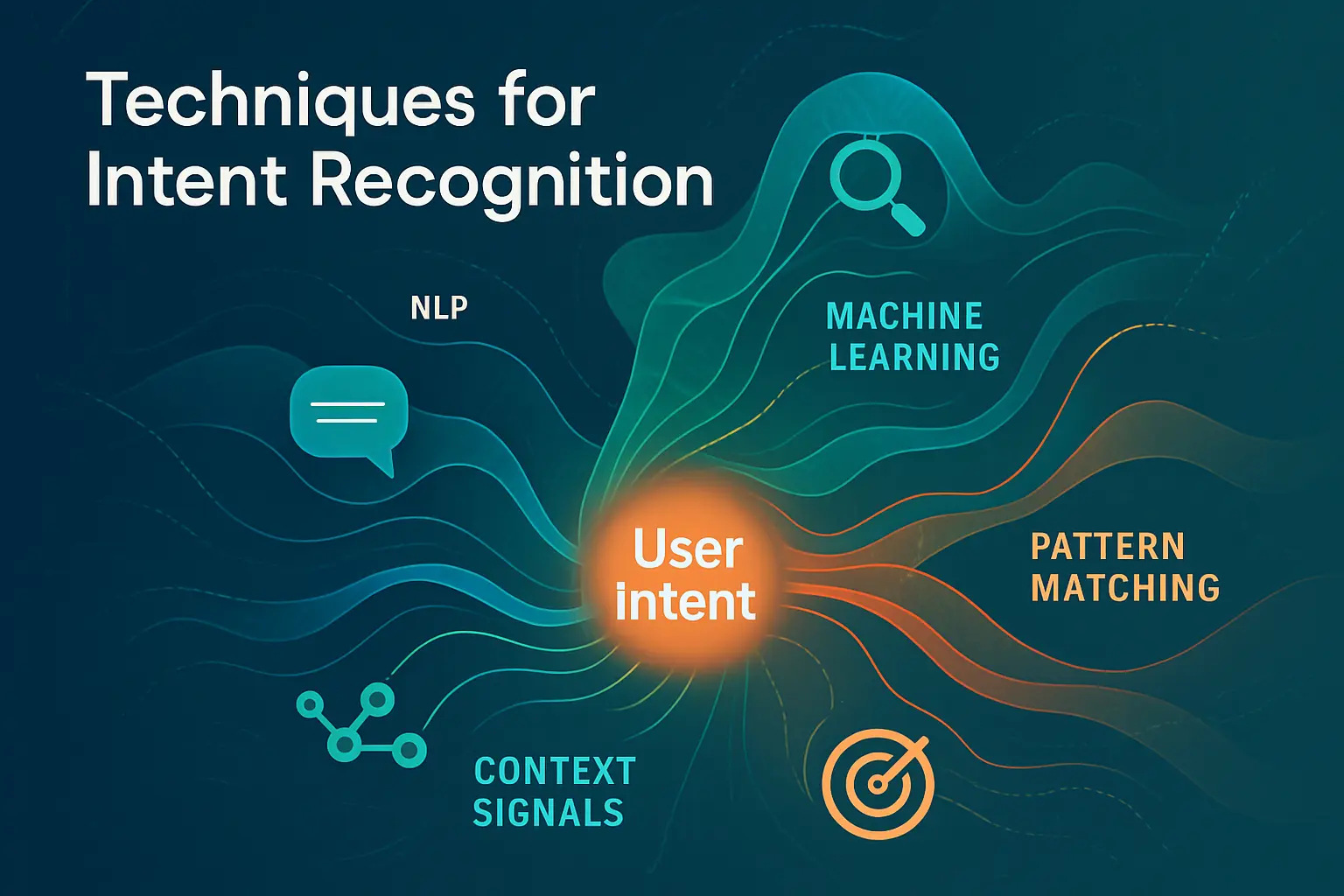
AI intent recognition involves classifying user queries in real time based on meaning, not just keywords. This includes techniques like semantic search, intent classification, and slot-filling to transform chaotic inputs into clear, actionable insights.
Keyword Matching vs. Semantic Understanding
Classical keyword searches are easily confused by typos and alternative phrasing. In comparison, semantic AI engines focus on intent and meaning, using embedding-based retrieval.
This technology allows your support system to understand messy input and deliver more accurate responses more consistently.
Intent Classification and Confidence Scoring
Intent classification sorts queries into predefined buckets (support, sales, information, etc.). Confidence scoring helps estimate how reliable these matches are.
When confidence is low, systems can prompt for clarification instead of guessing, which improves reliability and user trust.
Handling Ambiguous and Multi-Intent Queries
AI is built to handle messy, ambiguous, and multi-part questions. It can disambiguate by asking for clarification or break multi-intent queries into separate tasks, helping make sure nothing is missed and responses feel natural, even with complicated requests.
AI Models and Technologies Used
When trained on large datasets and enterprise knowledge, AI models can become better at predicting intent over time. This leads to more personalized service, higher efficiency, and improved customer outcomes.
Machine learning powers AI’s understanding of customer intent. Large language models (LLMs) and transformer-based algorithms break down and analyze complex queries. This helps AI to deliver increasingly intelligent and context-aware support.
Speech Profiling in Voice AI
Voice AI goes further than words, analyzing tone and emotional context. With speech profiling, systems can detect user mood, whether frustrated, happy, or confused, and adjust responses accordingly. This creates truly empathetic voice experiences.
Learn more about voice search optimization with AI here.
Decoding Intent in Different Contexts
Context shapes intent; what matters in e-commerce may be different from the priorities in finance or healthcare. By tailoring AI models to industry-specific language and scenarios, businesses improve accuracy and relevance.
E-commerce Search Intent
In e-commerce, intent drives everything. Whether users are browsing, researching, or ready to buy, AI-powered site search and product recommendation tools optimize the journey, prevent frustration, and boost sales.
AI-powered personalization can tailor the shopping process, helping improve relevance and support stronger conversion rates.
More on e-commerce SEO strategies here.
Caller Intent in AI Contact Centers
Contact centers use AI to decode why customers are calling, route them instantly, and reduce handle times. By recognizing caller intent, AI improves first-call resolution and minimizes the need for escalations, resulting in a better experience and more efficient operations.
Overcoming Challenges in Intent Recognition
AI intent systems must manage slang, accents, misspellings, and ambiguous phrasing. Effective solutions rely on robust NLP, adaptive learning, and minimizing misclassification to prevent negative feedback loops.
Dynamic models, rather than manually tuned systems, continually improve with new data, leading to smarter, more reliable service.
Enhancing Customer Experience through AI
AI elevates the customer journey by automating routine interactions, personalizing support, and anticipating needs. This boosts retention and operational efficiency, letting agents focus on complex issues.
As AI learns from every interaction, it becomes more adept, making each customer touchpoint seamless and satisfying.
Future Trends in AI Understanding of Customer Intent
The future of AI lies in predictive intent recognition, conversational shopping, and seamlessly integrated omnichannel support.
Expect AI to anticipate questions, not just answer them. This evolution will power next-gen customer experiences and help businesses maintain a competitive edge.
Integrating Multi-Channel Feedback
Unified AI platforms aggregate data across voice, chat, email, and messaging channels, providing a 360-degree view of customer needs.
This holistic feedback loop enables truly omnichannel intent recognition, enhancing engagement and rapidly adapting to changing behavior.
Hyper-Personalisation and Consistency Across Platforms
Hyper-personalization at scale requires maintaining cross-platform consistency. Contextual AI draws from profiles, behaviors, and tone preferences, delivering tailored interactions that build trust and loyalty, no matter the channel.
Further reading on creating personalized customer journeys here.
The Impact of AI on Customer Experience and Business Outcomes
AI is becoming a strategic partner driving revenue, efficiency, and customer loyalty. From predictive service to reduced costs and improved decision-making, the ROI of conversational AI can be significant when implemented well.
Conclusion
Understanding customer intent is no longer just a technical advantage. It is central to creating faster, smoother, and more relevant customer experiences.
By using AI to interpret messy queries, recognize context, and respond based on meaning rather than exact wording, businesses can reduce friction and guide customers toward the answers, products, or support they need.
As conversational AI continues to evolve, the companies that focus on intent will be better equipped to improve satisfaction, increase conversions, and build stronger customer relationships.