
First-Party Data Strategies SMEs Need in 2026
Karl Marais | 12 March 2026

Using data to drive your business can feel like assembling a puzzle with missing pieces. You know that a clear view of your customer is essential, yet evolving data privacy makes it harder to build a complete cross-platform picture.
But you don’t need to chase elusive third-party data. Opportunity lies in using the first-party data your business already owns.
In 2026, the SMEs that will gain the greatest advantage will be those that master their first-party data. Here’s how you can do the same.
Understanding the Importance of First-Party Data for SMEs
First-party data sits at the center of modern, privacy-conscious marketing.
Unlike third-party data, which is becoming less reliable as third-party cookies are phased out, first-party data is collected directly from your customers, giving small businesses a powerful, tailored approach to marketing.
By using data from your website, email lists, and other owned channels, SMEs gain a competitive edge and more reliable strategies.
First-party data is accurate, aligns with privacy regulations, and makes your business a trusted partner in your customers’ journey. It also enables personalized campaigns that foster loyalty, all while being cost-effective.
By tracking purchase history and website engagement, small businesses can transform first-party data into actionable insights, setting the stage for long-term success. Interested in boosting your online presence?
What is First-Party Data?
First-party data is information you collect directly from your customers through your own website, forms, purchase records, and communications.
It is typically collected with user consent or through direct customer interactions and provides deep insights into customer preferences and behaviors, allowing you to refine marketing and customer experience.
Combining first-party and zero-party data, details customers deliberately share, creates even stronger relationships and more precise targeting.
Advantages Over Third-Party Data
As privacy laws tighten, first-party data offers benefits such as better accuracy, compliance, and trust.
Compared with third-party data, it generally raises fewer ethical and transparency concerns and can be more easily managed for privacy and consent.
The trust your customers place in you by sharing their data leads to stronger relationships and sustained growth.
Why SMEs Must Prioritize It
First-party data can create a lasting competitive moat, especially crucial for SMEs with limited tech resources.
Small businesses don’t need costly external services; affordable tools can help them capture and analyze data in-house. Trust and transparency underpin this strategy, making it an essential evolution.
Strategies for Effective First-Party Data Collection
Collecting first-party data requires creating systems that are user-friendly, compliant, and valuable for customers.
Offer incentives, like discounts or exclusive content, in exchange for data. Focus on collecting data directly through owned channels and interactions with both known and anonymous users.
Expanding collection channels beyond your website ensures more opportunities for meaningful insights.
Website Forms & Surveys
Website forms, surveys, and quizzes help gather zero-party data, especially when paired with incentives like instant discounts. Well-designed feedback questions and easy-to-complete forms yield high-quality data and boost participation.
For best results, align surveys with specific actions (like post-purchase) and keep the user experience seamless.
Loyalty Programs
Loyalty programs are a rich source of first-party data. Points, club cards, and rewards encourage frequent engagement and provide insights into purchase behavior.
Each interaction refines your customer profiles, enabling smarter targeting and deeper relationships. Well-crafted programs double as ongoing data collection and engagement strategies.
Purchase Histories and Receipts
Purchase data reveals valuable patterns about customer behavior. Recording purchase histories and digital receipts provides vital data on customer habits.
Digital receipts and QR codes help link in-store and online purchases, enriching your data and helping improve attribution.
Social Media Engagement
Social media isn’t just good for awareness; it can be a valuable source of first-party data. Interactive content, contests, and giveaways not only engage but also capture valuable information.
Use link-in-bio tools and incentivized data collection tactics to convert followers into direct contacts. Learn more in Social Selling for SMEs here.
Building a Strong First-Party Data Technology Stack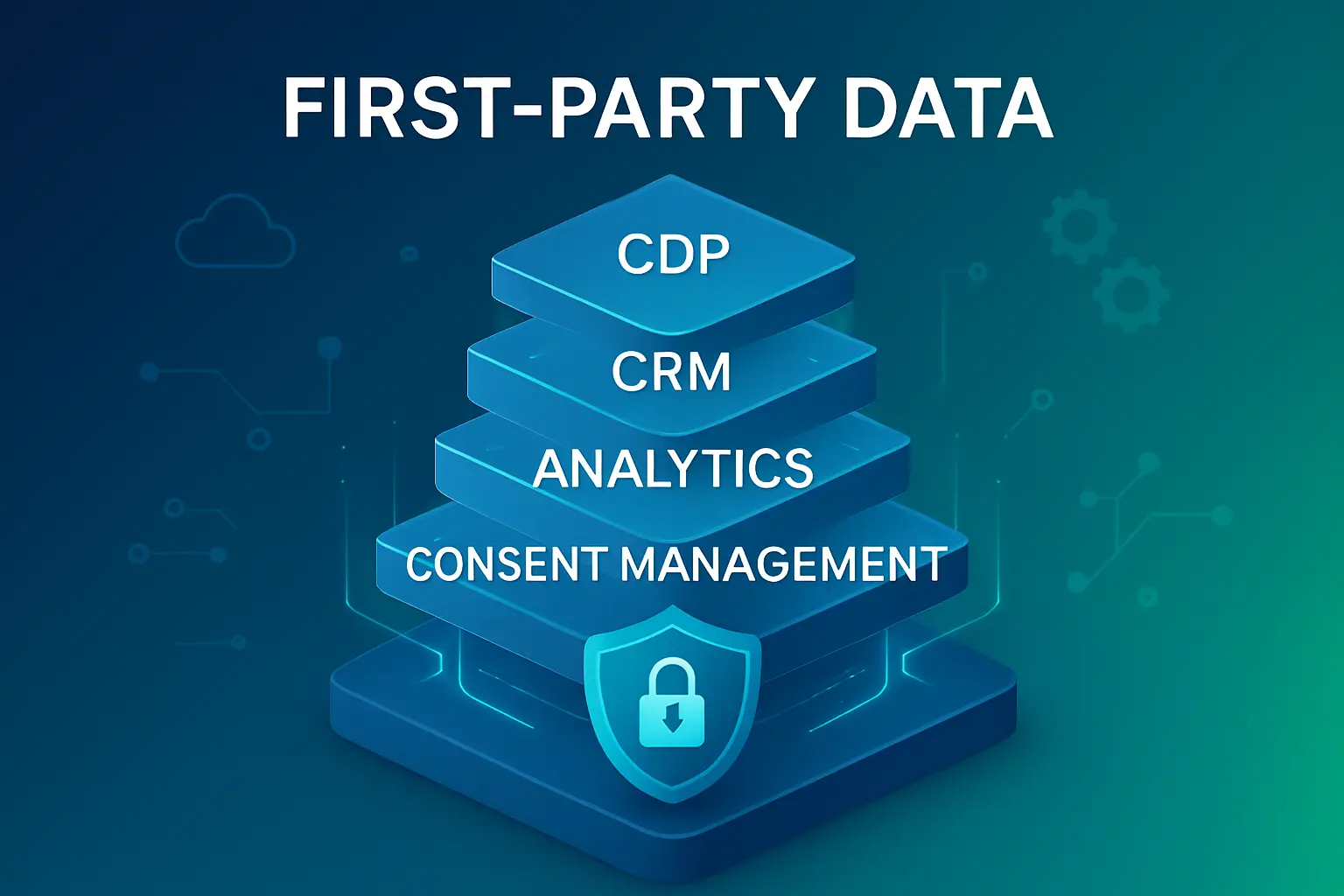
A robust first-party data technology stack is the foundation of your strategy. Choose tools that are budget-friendly yet cover essentials: a data platform for unifying customer data, business-critical integrations, and reliable data governance to ensure responsible handling.
Tools should integrate smoothly with your existing systems, creating a seamless flow for collecting, managing, and leveraging data.
Data Management Tools
Many businesses use a customer data platform (CDP) to unify data into actionable customer profiles. Support this with server-side tracking, identity resolution, tag management, and pixel tracking for detailed, accurate data.
CRM Integration
Integrate your CRM (like HubSpot or Salesforce) to build segmented audiences and personalize messaging. Feeding first-party data into your CRM helps ensure every interaction is as relevant as possible.
Analytics Platforms
Platforms like Google Analytics and Looker Studio translate unified data into insights, vital for decision-making and optimizing your marketing. Sophisticated analytics illuminate what’s working and where to improve.
Ensuring Privacy and Compliance
Respect for data privacy is crucial. Customers expect, and reward, transparency. Use a strong privacy-first approach, including consent management and clear privacy policies.
Stay current with major privacy frameworks such as GDPR and CCPA, which govern how businesses collect and use customer data.
Maintain clear records, enable opt-outs, and ensure staff remain up to date on regulatory requirements. Leveraging privacy compliance can help build trust and differentiate your brand. Our latest advice is in this data ethics post.
Privacy-First Data Strategies
Gain explicit consent and practice data minimization. Only collect what’s essential. Secure customer data via encryption and access controls. Regular audits help verify compliance and build customer confidence.
Compliance Checklists
Develop a compliance checklist covering data ownership, consent tracking, policy updates, and security protocols. This supports both regulatory needs and robust internal governance.
Leveraging First-Party Data for Growth

Using first-party data empowers smarter, data-driven decisions. It can enhance marketing ROI, uncover purchase patterns, and support revenue growth. The key is transforming raw data into actionable insights that drive personalized campaigns.
Personalizing Campaigns
Customers now expect more personalized interactions. Use customer insights for tailored content and offers, making every communication more relevant. Direct integrations enable one-to-one email and ad campaigns that connect and convert.
Segmentation and Targeting
Segmenting customers by behavior and preferences helps ensure more relevant messaging. Use lookalike audiences to find new prospects who resemble your most valuable customers, enhancing targeting and efficiency.
Retention and Engagement
Retention is as important as acquisition. Track churn risk, nurture high-value customers into superfans, and use ongoing engagement strategies for lasting loyalty.
Measuring and Optimizing Data Strategies
To ensure effectiveness, continually track and refine your data strategy. Adopt attribution models to identify top-performing channels and iterate based on real insights.
Key Performance Indicators
Focus on KPIs like ROAS, CAC, LTV, conversion rates, and data match rates. These metrics show what’s working and highlight where you can improve.
Continuous Improvement Techniques
Leverage A/B tests, incrementality testing, and media mix modeling for campaign optimization. These iterative methods strengthen your edge.
Analysis Tools
Attribution analysis, predictive analytics, and visual dashboards help you respond quickly and fine-tune your strategies.
Implementing a First-Party Data Strategy: A Step-by-Step Guide
Start by assigning responsibility for data. Audit your current data assets and infrastructure, clean your data, and identify gaps. Update privacy policies and ensure visible, accessible consent mechanisms.
Develop a short-term roadmap (e.g., a 90-day plan) to set goals and launch pilot campaigns, and track specific milestones and outcomes. Keep the plan flexible and adaptive, refining as you gather results.
Initial Setup & Audit
Review and clean existing data. Ensure all sources, from web to POS, are included, and align collection methods with privacy standards.
Building a 90-Day Plan
Define actionable steps, launch surveys and campaigns, measure early performance, and rapidly iterate based on feedback.
Scaling Strategies
Implement advanced segmentation, experiment with AI-driven insights, and scale up programs found effective in your pilot.
Long-term Strategy
Continue evolving your data practices, investing in scalable tech and analytics, and building a culture that adapts and learns from data.
Conclusion and Forward Look
Mastering first-party data is vital as third-party cookies are phased out and privacy demands rise. SMEs that act can secure a lasting competitive edge, deepening customer trust and driving growth through data-inspired decisions.
Stay adaptable, prioritize transparent data practices, and continually refine your strategies. The future belongs to SMEs who evolve, learn, and fully use the potential of first-party data.